Personalized Nasal & Facial Care • Dedicated International Patient Concierge


Deviated Septum Surgery
Nasal Valve Collapse
The nasal valve is the narrowest segment of the nasal airway.
Schedule a Consultation
What Is Nasal Valve Collapse in Functional Nasal Surgery?
The nasal valve is the narrowest segment of the nasal airway. It acts as the primary regulator of airflow entering the nose, and when it weakens or collapses — whether due to congenital structure, trauma, aging, or previous surgery — the consequences extend well beyond mild congestion.
Nasal valve collapse is classified into two main types. Internal nasal valve collapse involves the narrowing of the angle between the upper lateral cartilage and the nasal septum, reducing airflow at the mid-nasal level. External nasal valve collapse, by contrast, involves the alar sidewall — the outer rim of the nostril — which may cave inward during inhalation, partially or fully obstructing the airway.
Unlike a deviated septum or swollen turbinates, nasal valve collapse is a structural failure. The nasal framework itself has lost the rigidity needed to stay open during breathing. This is why many patients continue to experience obstruction even after septoplasty or turbinate reduction — because those procedures do not address valve integrity. Effective treatment requires reinforcing or reconstructing the valve itself using cartilage grafts to restore the architecture that breathing depends on.
At JNB Clinic, nasal valve reconstruction is approached as a precision structural procedure — not a secondary correction. The goal is to rehabilitate nasal anatomy in a way that is both functionally durable and aesthetically harmonious.
Who Needs Nasal Valve Collapse Treatment?
Nasal valve collapse is frequently underdiagnosed. Patients may spend years managing symptoms with nasal sprays, allergy medications, or external nasal strips — without ever addressing the underlying structural cause. If you recognize yourself in the following, a formal evaluation for nasal valve collapse may be appropriate:
-
Chronic nasal congestion on one or both sides that does not respond to medication
-
Noticeable difficulty breathing through the nose during physical activity or exercise
-
A sensation that the nostril collapses or "pulls inward" when inhaling
-
Snoring or sleep disturbances related to poor nasal airflow
-
Persistent nasal obstruction following a prior septoplasty or turbinate reduction
-
Nasal blockage that developed or worsened after rhinoplasty or facial trauma
-
One-sided nasal obstruction with no clear allergic or infectious cause
-
Ongoing nasal breathing difficulty despite previously normal diagnostic results
These presentations often indicate that the nasal valve — not just the septum or turbinates — is the primary site of obstruction. A proper structural assessment is the essential first step.
Meet the Specialist in Functional Nasal Surgery
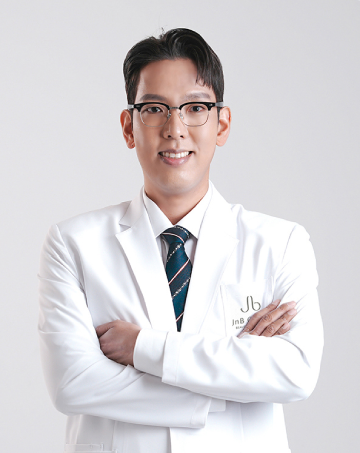
Dr. JuYong Kang
Representative Director & Chief Physician
JNB Clinic Plastic Surgery & Otolaryngology (ENT)
Dr. JuYong Kang Representative Director & Chief Physician, JNB Clinic Specialist in Otolaryngology (ENT) and Plastic Surgery
Dr. JuYong Kang trained at Kyung Hee University School of Medicine and completed his graduate medical education at Kyung Hee University Graduate School of Medicine. His dual clinical background in otolaryngology and facial plastic and reconstructive surgery gives him a comprehensive understanding of both the functional and structural dimensions of nasal anatomy — a combination that is particularly relevant in the treatment of nasal valve collapse.
His clinical scope includes rhinoplasty, nasal airway reconstruction, sleep disorder management, and stem cell therapy. He is fluent in both functional and cosmetic ENT medicine, and has served as director at multiple surgical clinics prior to founding JNB Clinic.
Dr. Kang holds full membership in six specialized professional societies, including the Korean Society of Otorhinolaryngology-Head and Neck Surgery, the Korean Rhinologic Society, the Korean Society of Facial Plastic and Reconstructive Surgery, and the Rhinoplasty Research Society of the Korean Society of Plastic and Reconstructive Surgeons.
His guiding philosophy: "Beautiful, comfortable breathing is where it all begins. The harmony between natural breathing and the face is more important than anything else."
This dual focus — restoring function while maintaining or improving facial aesthetics — defines the JNB approach to nasal valve surgery.
Treatment Areas and Expected Improvements
Nasal valve reconstruction at JNB Clinic addresses multiple anatomical targets depending on the specific type and severity of collapse identified through diagnostic evaluation.
-
**Internal nasal valve angle: **The angle formed between the upper lateral cartilage and the septum is the most common site of internal nasal valve collapse. When this angle narrows below the functional threshold, airflow is significantly reduced. Spreader grafts — small pieces of cartilage placed between the upper lateral cartilages and the septum — are used to widen this angle and restore adequate airway cross-section. Patients typically experience a noticeable improvement in nasal airflow from both nostrils after recovery.
-
External nasal valve and alar sidewall: External collapse involves the lateral wall of the nostril losing rigidity and collapsing inward during inhalation. Alar batten grafts are placed to reinforce the external valve structure, preventing sidewall collapse during breathing. This is particularly relevant for patients who notice visible inward movement of the nostril when inhaling deeply or during exercise.
-
Nasal septum: When a deviated septum contributes to — or coexists with — nasal valve collapse, septoplasty can be performed simultaneously. Precise correction of septal deviation restores the internal nasal framework and removes a key contributor to airway resistance.
-
Inferior turbinates: Enlarged or hypertrophied inferior turbinates frequently accompany nasal valve problems and compound the degree of obstruction. Inferior turbinate reduction is performed when indicated to further open the nasal airway and improve breathing comfort.
-
Expected improvements: following surgery include reduced nasal resistance during breathing, improved exercise tolerance, reduced snoring, more restful sleep, and decreased reliance on nasal sprays or other symptom-management tools. Results are dependent on the severity of the initial collapse, the structures involved, and individual healing response. Improvement is gradual and becomes more apparent as postoperative swelling resolves over weeks to months.
Treatment Process and Timeline
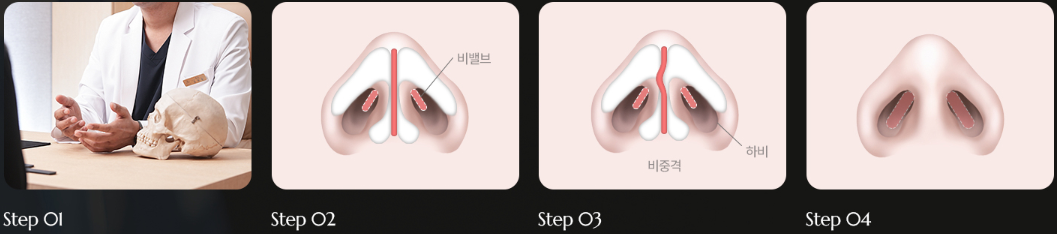
Step 1 — Comprehensive Consultation and Evaluation
The treatment journey at JNB Clinic begins with a detailed consultation in which the patient's symptoms, medical history, and prior nasal procedures are reviewed. Dr. Kang conducts a physical examination alongside nasal endoscopy to directly visualize the internal nasal structures. 3D-CT imaging is then used to produce a three-dimensional analysis of the nasal cartilage, bone framework, valve angle, and degree of septal deviation. This imaging allows the surgical team to identify both dynamic collapse — which occurs during inhalation — and static collapse, which is present at rest.
Step 2 — Personalized Surgical Planning
Based on the diagnostic findings, a customized surgical plan is developed. This plan specifies the type and location of cartilage grafts to be used, whether simultaneous septoplasty or turbinate reduction is indicated, and the expected surgical sequence. The source of autologous cartilage — septal, ear, or rib — is selected based on the volume and type of structural support required.
Step 3 — Nasal Valve Reconstruction
Surgery is performed endoscopically to minimize external disruption. The collapsed valve area is precisely accessed and reconstructed using the patient's own cartilage. Grafts are shaped and positioned to restore structural support to the affected valve segments. When spreader grafts or alar batten grafts are required, they are placed with careful attention to symmetry and long-term structural integrity.
Step 4 — Simultaneous Septal and Turbinate Correction (When Indicated)
If the diagnostic evaluation identified a contributing septal deviation, septoplasty is performed during the same surgical session. Inferior turbinate reduction may also be carried out at this time. Combining these procedures reduces total recovery burden and addresses all contributing causes of obstruction in a single operation.
Step 5 — Immediate Postoperative Care
Following surgery, patients are monitored in recovery before discharge, typically on the same day. A personalized postoperative care protocol is provided, including guidance on swelling management, activity restrictions, and hygiene around the nasal area during the initial healing phase.
Step 6 — Follow-Up and Long-Term Monitoring
Scheduled follow-up appointments allow the surgical team to monitor healing, manage any inflammation, and assess airway improvement over time. The initial recovery period — during which most swelling and discomfort resolve — is approximately one to two weeks. Structural healing and full airway improvement continue to develop over the following months as the grafted cartilage integrates with the surrounding tissue.
Results, Safety, and Longevity
Nasal valve reconstruction using autologous cartilage is designed to produce stable, long-lasting structural improvement. Because the patient's own tissue is used — rather than synthetic implants — the biological response is more predictable, with lower risk of rejection, migration, or material-related complications. Over time, the grafted cartilage integrates naturally with the surrounding nasal framework.
The use of the patient's own cartilage also means the reconstructed valve maintains a natural feel and appearance, without the stiffness or visible irregularity that can sometimes occur with foreign materials.
From a safety standpoint, the endoscopic approach minimizes external scarring and reduces the degree of tissue disruption compared to open approaches. Dr. Kang's dual training in ENT and facial plastic surgery allows for simultaneous management of both the functional and aesthetic dimensions of the nasal structure.
Common postoperative experiences include temporary swelling, mild discomfort, and nasal congestion during the initial healing phase. These are expected and typically resolve within the first one to two weeks. As with any surgical procedure, individual outcomes vary, and results depend on the specific anatomy, the severity of collapse, and how each patient heals.
No surgical outcome can be guaranteed. Patients are encouraged to discuss realistic expectations thoroughly during their consultation, including any factors that may influence their individual result.
Why Choose JNB Clinic for Nasal Valve Collapse Treatment?

Nasal valve collapse is one of the most technically demanding conditions in functional nasal surgery. It requires a surgeon who understands not only where the collapse is occurring, but why — and who has the structural surgical skill to correct it in a way that holds over time. At JNB Clinic, this level of diagnostic precision and surgical specificity is foundational to every case.
Dr. JuYong Kang's dual expertise in otolaryngology and facial plastic and reconstructive surgery means that each treatment plan is evaluated from both a functional and anatomical perspective. Rather than applying a standard correction, the team at JNB Clinic maps the exact pattern of each patient's nasal valve collapse — internal, external, or combined — and designs a reconstruction that addresses it directly.
The clinic's integrated approach to simultaneous correction — addressing nasal valve collapse, septal deviation, and turbinate hypertrophy in a single operation — reduces total treatment burden and eliminates the need for staged procedures in appropriate candidates. Patients who have previously undergone septoplasty or rhinoplasty without adequate relief are particularly well served by this comprehensive model.
Key reasons patients choose JNB Clinic:
-
3D-CT-based precision diagnosis — imaging allows structural analysis in three dimensions before any surgical decision is made
-
Autologous cartilage-only reconstruction — no foreign implants; only the patient's own tissue is used to ensure natural integration and long-term stability
-
Simultaneous multi-structure correction — nasal valve, septum, and turbinates addressed in one procedure when clinically appropriate
-
Dual-specialty expertise — Dr. Kang's ENT and facial plastic surgery background ensures both airway function and facial harmony are considered
Real Patient Experiences
Patient A — Post-Rhinoplasty Breathing Difficulty
A patient in their late thirties presented with progressive nasal obstruction that had developed following a cosmetic rhinoplasty performed elsewhere several years prior. Diagnostic evaluation at JNB Clinic identified external nasal valve collapse caused by over-reduction of the alar cartilages during the prior procedure. Alar batten grafts using ear cartilage were placed endoscopically to restore lateral wall support. The patient reported significant improvement in nasal breathing within the first month following surgery.
Patient B — Chronic One-Sided Nasal Obstruction
A patient in their mid-forties had experienced right-sided nasal blockage for over a decade, having been previously told that their septum was only mildly deviated. 3D-CT imaging at JNB Clinic revealed a significant internal nasal valve angle narrowing on the right side in addition to the septal deviation. Spreader graft placement combined with septoplasty was performed simultaneously. At six-week follow-up, the patient described the improvement in airflow as dramatic.
Patient C — Sleep and Exercise-Related Breathing Difficulty
A patient in their early fifties sought evaluation after years of snoring, disrupted sleep, and an inability to breathe through the nose during moderate exercise. Evaluation confirmed bilateral internal and external nasal valve collapse with associated inferior turbinate hypertrophy. A comprehensive reconstruction including spreader grafts, alar batten grafts, and turbinate reduction was completed in a single procedure. At three months post-surgery, the patient reported significantly improved sleep quality and the ability to sustain nasal breathing during exercise for the first time in years.
Begin Your Path to Restored Nasal Breathing
If nasal congestion, difficulty breathing, snoring, or sleep disruption has become a persistent part of your daily life — and previous treatments have not provided lasting relief — nasal valve collapse may be the underlying cause.
At JNB Clinic, Dr. JuYong Kang and his team offer a structured, evidence-based pathway from precise 3D-CT diagnosis through surgical reconstruction and long-term follow-up care. Every treatment plan is built around your specific anatomy, your symptoms, and your goals — not a generalized protocol.
Schedule a consultation with JNB Clinic today to receive a comprehensive evaluation of your nasal airway and learn whether nasal valve reconstruction is appropriate for your condition. Our team is experienced in supporting international patients throughout every stage of the process, from initial inquiry through post-surgical recovery.
Contact JNB Clinic directly to arrange your appointment or to submit an inquiry for a preliminary assessment.
Breathing well is the beginning of feeling well. Let us help you get there.
Other Services
Explore additional treatments offered by our specialists.

Silhouette Lifting
Silhouette Soft is a minimally invasive, absorbable thread lift that repositions sagging facial tissue while simultaneously triggering the skin's natural collagen production.
Learn More

Botox
Botox — short for botulinum toxin — is a refined, medical-grade protein that temporarily reduces the activity of targeted facial muscles.
Learn More

Facial Liposuction
Facial liposuction is a minimally invasive contouring procedure that removes localized fat deposits from specific areas of the face and lower face.
Learn More