Personalized Nasal & Facial Care • Dedicated International Patient Concierge

Medical Guide
Thread Lift Options: Comparing Materials and Methods
Thread lifting options Korea: how absorbable thread materials and anchoring designs differ, what each suits, and how the choice is made at consultation.
Schedule a ConsultationUnderstanding Your Thread Lift Options Beyond Silhouette
Medically reviewed by Dr. Kang Ju-Yong, Korean Board-Certified Otorhinolaryngologist (ENT Specialist)
Patients researching thread lifting options in Korea quickly discover that "thread lift" is a category, not a product — and that the category contains several different materials and several different ways of anchoring tissue. JNB Clinic offers two entries within it: Silhouette Lifting, and a general Thread Lifting service. This article explains what separates one thread approach from another, what both share, and which parts of the decision genuinely belong in a consultation rather than in an article.
Two Variables Define Every Thread Lift
Strip away the product names and the choices reduce to two questions: what is the thread made of, and how does it grip tissue?
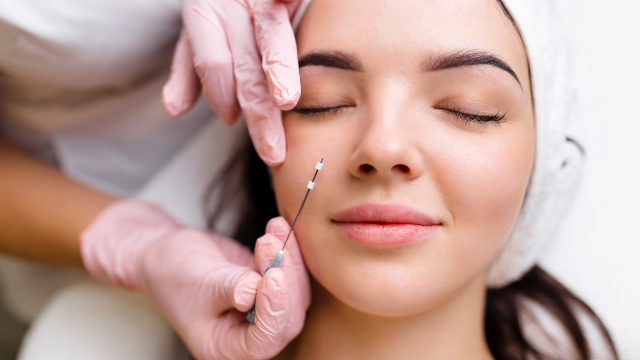
JNB Clinic's documentation describes both of its thread services in those terms. Its general Thread Lifting entry uses dissolvable threads, commonly of PDO or PLLA material, placed under the skin through a fine needle or cannula in a pattern intended to lift sagging tissue mechanically, while collagen production is stimulated as the material gradually absorbs over the following months. Its Silhouette Lifting entry is described as a suture-based treatment in the Silhouette Soft category, using absorbable PLLA sutures carrying bidirectional cones, placed through a fine cannula, giving an immediate mechanical lift along with longer-term collagen stimulation.
So the two entries share a principle and differ in the detail. Both are absorbable. Both do two things at once — reposition tissue now, and leave behind a stimulus that acts later. What separates them is the anchoring geometry and, in the general service, the possibility of a different polymer.
What the Materials Are
Poly-L-lactic acid will be unfamiliar to most patients as a name and entirely familiar as an object.
The American Society of Plastic Surgeons (ASPS), describing polylactic acid in a different context — as an injectable that stimulates the body's own collagen rather than filling a line directly — notes that this non-toxic, biodegradable substance has been in use for more than four decades as suture material. That is the relevant lineage for a thread lift: the polymer was a surgical suture long before it became an aesthetic one.
ASPS also captures the behavior that distinguishes a stimulator from a filler. A stimulator does not produce an immediate change by occupying space; it prompts the body to make collagen, so the effect emerges gradually across a period of months. The American Society for Dermatologic Surgery (ASDS) lists the same material in its treatments directory under the commercial name Sculptra.
A thread made of this polymer combines both behaviors in one object. The mechanical lift is immediate because the thread physically holds tissue. The collagen response is delayed, and continues as the material is absorbed.
Polydioxanone, the other material JNB Clinic names, belongs to the same broad story: an absorbable surgical polymer repurposed into an aesthetic device.
Anchoring: Cones Versus Barbs Versus Smooth
A thread that cannot grip tissue cannot lift it. How the grip is achieved is what most product differences come down to.
The clinic documents bidirectional cones on its Silhouette Soft threads — small structures that engage tissue in two directions from a central point, so that tension is distributed on both sides rather than pulling from one end. Other thread designs rely on barbs cut or molded into the thread, and some threads are smooth, placed not to lift but to lay down a stimulus for collagen in a defined area.
A patient comparing offers is therefore sometimes comparing a lifting device with a stimulating one. The useful question at consultation is not "which brand" but "is this thread meant to reposition my tissue, or to improve the texture and firmness of a zone?" The answer changes what a reasonable expectation looks like.
The number of threads placed, and the vectors along which they run, belong to the same discussion. A lift is produced by direction as much as by tension, and a plan that sets out which way each thread will pull is a plan that has been drawn for a particular face rather than copied from a catalog. Patients sometimes arrive asking for a specific count; the more useful request is an explanation of what each placement is meant to move.
What Thread Lifting Is Documented to Achieve
JNB Clinic's stated candidates for Thread Lifting are patients concerned about facial sagging, declining skin elasticity, jawline definition and signs of aging who want a lifting result without extensive surgery. For Silhouette Lifting, the documented group is patients with mild to moderate facial sagging who want a non-surgical procedure and a natural-looking outcome.
The approved claims the clinic carries for Thread Lifting are that it helps lift sagging skin, improves facial contour, increases skin elasticity, stimulates collagen production and contributes to a more youthful appearance. For Silhouette Lifting the claims are facial lifting, collagen stimulation, improved elasticity and natural-looking rejuvenation using absorbable PLLA threads. The clinic adds that individual results differ.
On duration, the clinic documents an immediate lift at the time of treatment, continued collagen benefit over the following months, and a result commonly lasting six to eighteen months depending on the specific thread material used. That is a range, not a promise, and the width of it is the honest part.
Recovery and What Can Go Wrong
Thread lifting sits further along the invasiveness scale than an energy-based device, and its recovery reflects that.
The clinic describes swelling, bruising and mild tenderness for several days to around a week, and notes that some patients experience temporary dimpling or a pulling sensation that resolves as the swelling goes down. Within its wider lifting category it lists the risks that belong specifically to threads: dimpling, visibility of the thread, asymmetry, and the rare possibilities of extrusion or infection. Final settling across the lifting category is described as taking two to four weeks.
The clinic's procedure time for its general Thread Lifting service is approximately 30 to 40 minutes.
Its guidance on postponement matches the rest of the lifting category: patients who are pregnant, who have an active skin infection where treatment would be placed, or who have not completed a consultation confirming that the treatment suits them, should be evaluated before proceeding.
The American Academy of Dermatology (AAD) adds a general warning that applies to every minimally invasive tightening approach: these procedures may give more noticeable results than non-invasive ones, but they still cannot deliver what a surgical procedure delivers, though they ask less downtime and carry less risk of side effects in exchange.
Who Does Well, and Who Does Not
AAD's candidate guidance for non-surgical tightening is the clearest short list available. The people most likely to be satisfied maintain a steady, healthy weight, eat well, do not smoke, drink little alcohol, and protect their skin from sun exposure without resorting to tanning beds. The decisive item on the list is the last: a small amount of sagging skin. Where laxity is extensive, AAD says directly that skin tightening may not help.
AAD also names pregnancy, skin infection and certain medications as reasons a tightening procedure is not appropriate.
ASPS frames the same boundary from the other direction. Minimally invasive rejuvenation cannot reproduce the result of a surgical lift; what it can do is postpone the moment at which surgery becomes the relevant question, and complement surgical results when that moment arrives.
Anyone being told that threads are equivalent to surgery is being told something those two bodies do not support.
How the Choice Is Actually Made
JNB Clinic's documented consultation for thread lifting begins with the physician evaluating facial balance, skin condition and what the patient needs lifted, then building a plan around that individual's goals and anatomy, with attention to natural facial harmony rather than a maximal pull.
For Silhouette Lifting the described process is the same in structure: facial condition, skin elasticity and overall balance are evaluated, and the method is chosen from that assessment.
The clinic's stated approach to reducing risk for thread work is that the procedure is performed by experienced medical professionals using absorbable threads designed to stimulate collagen while providing lift, with treatment planning built around each patient's facial condition. Threads may be combined with other treatments in the lifting program where that suits the individual plan.
What this means in practice is that the brand name is the last decision, not the first. Which tissue needs repositioning, in which vector, and whether the skin quality can support it — those come first, and they cannot be settled remotely.
Patients weighing the options often find it useful to look at the clinic's before-and-after gallery alongside a consultation, and questions can be sent through the contact page.

The Bottom Line
- Thread lifts differ along two axes — the absorbable material used, and how the thread anchors tissue; brand names mostly encode those two choices.
- JNB Clinic documents Silhouette Lifting as absorbable PLLA sutures with bidirectional cones, and a general Thread Lifting service using dissolvable PDO or PLLA threads placed via fine needle or cannula.
- Every absorbable thread does two jobs: an immediate mechanical lift, plus collagen stimulation as the material absorbs; the clinic describes results commonly lasting six to eighteen months depending on the material.
- Documented recovery is swelling, bruising and tenderness for several days to about a week, with possible temporary dimpling or a pulling sensation; thread-specific risks include visibility, asymmetry and rare extrusion or infection.
- AAD states that extensive sagging may not respond to tightening at all, and ASPS that minimally invasive work cannot match a surgical lift — which is where the consultation does the real work.
Frequently Asked Questions
What is the difference between Silhouette Lifting and the clinic's general thread lifting?
The clinic documents Silhouette Lifting as absorbable PLLA sutures carrying bidirectional cones in the Silhouette Soft category. Its general Thread Lifting service uses dissolvable threads commonly made of PDO or PLLA, placed in a pattern designed for mechanical lift.
How long do thread lift results last?
The clinic's documented expectation is an immediate lift followed by collagen benefit over subsequent months, with the result commonly lasting six to eighteen months depending on the thread material. Individual results differ.
How long does the procedure take?
The clinic states that its Thread Lifting procedure takes approximately 30 to 40 minutes.
Is thread lifting painful?
Discomfort is described as generally mild and managed with topical numbing where relevant. The more common complaint afterwards is a temporary pulling sensation, which the clinic notes resolves as swelling settles.
What can go wrong?
Within its lifting category the clinic lists dimpling, thread visibility, asymmetry, and rare extrusion or infection, alongside the usual swelling and bruising. These belong in the consent conversation before, not after.
Who should not have a thread lift?
Pregnancy, a skin infection active where threads would be placed, and not yet having had the consultation that confirms the fit are the three the clinic names. AAD adds that where there is a large amount of sagging skin, tightening procedures may not help.
Is a thread lift the same as a facelift?
No. ASPS states that minimally invasive rejuvenation cannot achieve surgical results, although it may delay the point at which surgery becomes appropriate. AAD describes minimally invasive tightening as more effective than non-invasive methods but still short of surgery.
Can threads be combined with other treatments?
The clinic documents thread lifting as part of its lifting program and states that combinations are designed around individual facial balance and goals when appropriate.
Offered for informational purposes and educational purposes as general reading, this page is not a self-diagnosis tool and no article can determine candidacy; that judgment belongs to a qualified medical professional who has examined the face in question.
More Articles
Continue reading our clinical guides.

Benefits of Stem Cell Therapy for Skin Rejuvenation
Discover the benefits of stem cell therapy for skin rejuvenation, including improved texture, reduced wrinkles, and a more youthful appearance.
Learn More

Recovery After Autologous Cartilage Nose Surgery
Learn what to expect during recovery after autologous cartilage nose surgery, including healing timelines, aftercare tips, and results.
Learn More

Revision Rhinoplasty: Everything You Need to Know Before Your Second Nose Surgery
Revision Rhinoplasty: Learn what to expect from a second nose surgery, including risks, recovery, and results. Explore your options and learn more.
Learn More