Personalized Nasal & Facial Care • Dedicated International Patient Concierge

Medical Guide
Rhinoplasty With Thick Nasal Skin: Planning Challenges
Thick nasal skin rhinoplasty challenges: why a heavy covering layer limits fine tip definition, how support is planned, and why swelling settles slowly.
Schedule a ConsultationRhinoplasty for Patients with Thick Nasal Skin: Unique Planning Challenges
Medically reviewed by Dr. Kang Ju-Yong, Korean Board-Certified Otorhinolaryngologist (ENT Specialist)
Thick nasal skin rhinoplasty challenges are mostly challenges of translation. The surgeon can reshape the bone and cartilage underneath with precision; what the mirror shows afterwards depends on how faithfully the covering layer transmits that new shape. Where the soft tissue envelope is heavy — particularly over the tip — a given amount of structural work produces less visible refinement than the same work would under thin skin. Understanding that relationship before surgery is the difference between a sensible plan and a disappointed patient.
What "Thick Skin" Actually Describes
The outer layer of the nose is not uniform. It is thinner over the bridge and thickest around the tip and the alar region, and the amount of fat and fibrous tissue beneath it varies considerably from person to person.
Thickness in this sense is not a flaw. A heavier envelope is more forgiving of minor contour irregularities, tends to resist the hollowed or over-operated look, and often ages more gracefully. What it does not do is drape tightly into sharply defined angles. Fine detail carved into the cartilage beneath can simply be absorbed.
That is why thickness is assessed rather than assumed. JNB Clinic's by-type program runs a high-resolution 3D scan covering the facial contour, the structure already present and the thickness of the covering layer, and that scan precedes the design. In its autologous cartilage program the covering layer is measured alongside the bridge, the tip, the septum, cartilage quality and breathing function at the opening assessment. Skin thickness also appears in the clinic's documented consultation for nose tip surgery, together with tip shape, cartilage structure, nasal support, breathing function and the patient's desired outcome.
The American Society of Plastic Surgeons (ASPS) likewise names skin thickness among the patient-specific factors a surgical plan has to accommodate.

The Definition Ceiling
Here is the point most often skipped in consultations that go badly.
Reducing cartilage does not automatically reduce the apparent size of the tip, because the covering layer does not shrink to match. Beyond a certain point, taking more away produces no further visible refinement — and may compromise support, which creates problems later.
Where the tip is genuinely bulbous, the clinic's documented correction does not rely on cartilage reduction alone. For the bulbous sub-type, it describes removing excess fat and muscle beneath the skin to produce a sleeker tip, then binding the splayed cartilage and reinforcing it with the patient's own cartilage, with a cartilage graft optionally added to refine and raise the tip further.
That sequence is instructive. One part of it addresses the covering layer. One part reorganizes the splayed framework. One part adds support so the new shape is held. A plan that does only the third and hopes the envelope follows is working against the anatomy.
The clinic's stated approach for its tip work is refinement of shape and projection as part of the by-type program — bulbous or drooping tip correction, for instance — and its own guidance for this service is to avoid promising a specific tip shape without individualized consultation. Individual results vary and are not guaranteed.
Projection Instead of Subtraction
The strategy that tends to make sense under a heavier envelope is to project the structure outward rather than to carve it inward. A framework pushed forward and supported tents the soft tissue, which produces visible shape; a framework reduced under heavy tissue tends to disappear.
ASPS describes where surgeons obtain that structural material. Cartilage grafts may be added, most commonly taken from the septum in the middle of the nose, occasionally from the ear, and rarely from a rib; an overly large nose may instead be reduced by removing bone or cartilage, depending on what the design requires.
JNB Clinic works within that same anatomy but with a stated preference about material. Its signature program avoids synthetic implants altogether, rebuilding and augmenting with tissue harvested from the patient — ear, rib or septum — and donor sites are evaluated during planning so the chosen source matches what the design asks for. The clinic describes the resulting approach as structural support built from the patient's own tissue, with the aim of stability over time.
For a patient with a heavy envelope, the practical consequence is that the conversation should be about how much support the design calls for and where that support will come from — not about how much tissue will be removed.
Swelling Follows a Slower Curve
Patients with thicker nasal skin should expect the waiting period to feel long, because the covering layer that absorbs definition also holds swelling.
ASPS sets the general expectation for all rhinoplasty patients: initial swelling subsides within a few weeks, but it may take as long as a year for the new nasal contour to fully refine, and the appearance of the nose changes gradually across that period.
JNB Clinic describes recovery after autologous cartilage nose surgery as typically taking two to six months depending on the individual case, with the nose becoming progressively more stable and refined through healing. Swelling and bruising are expected in the early phase, and the clinic states that the final shape of the nose gradually improves over time.
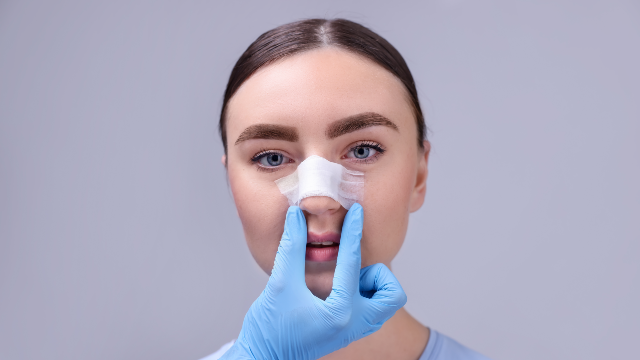
The clinic's structured aftercare is organized around that curve. The post-surgery program is scheduled in three stages: the splint comes off at about day two, with hyperbaric oxygen and LED care; sutures and relay care follow near day seven; and medical skin scaling plus a further hyperbaric oxygen session fall at the two-week mark. The clinic describes following patients for up to one year afterwards. Its wider aftercare system is documented as including swelling management, healing assessment and follow-up visits to evaluate recovery.
Judging the result of tip surgery at six weeks under a heavy envelope is judging swelling, not shape.
Breathing and Structure Are Part of the Same Plan
Tip work is not only cosmetic. The lower third of the nose contains the structures that keep the airway open, and reducing or weakening them without replacing support can narrow the airway over time.
ASPS includes airway correction within the operation itself. A deviated septum, it notes, can be straightened during surgery, with the internal projections reduced so that breathing improves.
JNB Clinic's documented position treats the nose as a functional structure at least as much as a cosmetic one, with every procedure planned around the airway, the internal anatomy and stability over time as well as the external result. The by-type program is described as joining functional and aesthetic techniques, and a sub-type correction may be paired with functional work where the airway needs it. Dr. Kang Ju-Yong holds a South Korean medical license and board certification in otorhinolaryngology; the specializations the clinic lists for him include implant-free, revision, functional and closed rhinoplasty.
For a patient whose tip is being reinforced rather than reduced, that functional framing is not a side benefit. Reinforcement is what protects the airway while the shape is changed.
Setting Expectations Before, Not After
ASPS's planning guidance for aesthetic surgery puts candor first. At the opening appointment patients are asked to set out, at length, their reasons for wanting the procedure and the result they are hoping for, and should leave that appointment confident that surgeon and patient are describing the same thing. ASPS then adds the caution that matters most here: expectations should be realistic, because what a surgeon offers is significant improvement rather than perfection, and both age and health can bear on the quality of the result.
Applied to a heavy soft tissue envelope, realistic means something specific. It means accepting that the degree of definition achievable is bounded by the covering layer; that the change may read as a refinement of proportion rather than a sharpened point; and that the final appearance arrives slowly.
A surgeon who raises these limits unprompted is doing the job. One who promises a particular tip shape without having assessed the skin is not describing your nose.
Appointments and questions ahead of travel go to the contact page, while the about page describes how the practice approaches assessment and planning.
What the Operation Involves
For context, ASPS describes the standard steps. Medication is given for comfort, with intravenous sedation or general anesthesia. The procedure is performed either closed, with incisions hidden inside the nose, or open, with an incision across the columella between the nostrils. The skin covering the nasal bones and cartilages is raised so the structure can be reshaped. Cartilage may be removed or added. A deviated septum can be straightened. The skin and tissue are then redraped and the incisions closed, with additional incisions sometimes placed in the natural creases of the nostrils to alter their size. Splints and gauze packing may support the nose for a few days.
JNB Clinic notes that two of its three signature techniques are performed through closed, endonasal approaches without external incisions, with technique selection made after the anatomical assessment rather than before it.
ASPS's preparation list applies in the usual way: lab work may be requested, medications may need adjusting, smoking should stop, and aspirin, anti-inflammatories and herbal supplements are set aside because of their effect on bleeding.
Questions to Bring
From the ASPS consultation checklist, the items with particular force for this group: whether I am a good candidate, which surgical technique is being recommended and why, what the risks and complications of my own procedure are, how my nose can be expected to look as the years pass, and what options would exist if the cosmetic result disappoints me.
Add the envelope-specific questions. How would you describe my skin thickness, and what does it mean for the definition this design can produce? Is the plan adding support, reducing structure, or both? Will anything be done about the soft tissue itself? At what point should I judge the result rather than the swelling?
The Bottom Line
- A heavier soft tissue envelope absorbs fine definition, so the same structural work shows less than it would under thinner skin.
- JNB Clinic assesses skin thickness explicitly, using high-resolution 3D scanning alongside evaluation of the bridge, tip, septum, cartilage quality and breathing function.
- The clinic's documented bulbous-tip correction addresses the covering layer, the splayed cartilage and added support rather than relying on reduction alone.
- Swelling resolves slowly: ASPS states the contour may take up to a year to fully refine, and the clinic describes recovery as typically two to six months with gradual improvement.
- Realistic expectations are the key variable; the clinic's own guidance is to avoid promising a specific tip shape without individualized consultation, and it states that results vary and are not guaranteed.
Frequently Asked Questions
Does thick skin mean I should not have rhinoplasty?
No. It means the plan and the expectations have to account for it. The clinic assesses skin thickness as part of its standard consultation and selects technique after that assessment rather than before.
Why can't the surgeon just remove more cartilage?
Because the covering layer does not contract to match, and because the lower third of the nose provides structural and airway support. Past a point, further reduction produces no additional definition and can weaken support.
Can anything be done about the soft tissue itself?
For the bulbous sub-type, the clinic documents removing excess fat and muscle beneath the skin as part of the correction, before binding and reinforcing the splayed cartilage. Whether that applies to an individual nose is a consultation question.
How long until I see the real shape?
ASPS states that swelling settles within a few weeks but the contour can take up to a year to refine fully. The clinic describes its own recovery expectation as two to six months, with follow-up continuing for up to one year.
Is grafting more likely in my case?
ASPS describes cartilage grafts as commonly taken from the septum, occasionally the ear and rarely a rib, depending on the design. The clinic's program is implant-free and evaluates donor sites during planning; what a specific design requires is determined at consultation.
Will my breathing be affected?
Structural support in the lower nose relates directly to the airway. The clinic documents combining functional and aesthetic techniques and may add functional correction such as septoplasty where breathing correction is needed.
What aftercare is provided?
Care is scheduled in three stages across the opening fortnight — splint off, sutures out, then medical skin scaling — with swelling management and continuing review afterwards, including remote follow-up once international patients have traveled home.
Issued for informational purposes and educational purposes, this article is general information and not a self-diagnosis tool; what a particular nose and its covering tissue can achieve is assessed by a qualified medical professional in person.
More Articles
Continue reading our clinical guides.

Benefits of Stem Cell Therapy for Skin Rejuvenation
Discover the benefits of stem cell therapy for skin rejuvenation, including improved texture, reduced wrinkles, and a more youthful appearance.
Learn More

Recovery After Autologous Cartilage Nose Surgery
Learn what to expect during recovery after autologous cartilage nose surgery, including healing timelines, aftercare tips, and results.
Learn More

Revision Rhinoplasty: Everything You Need to Know Before Your Second Nose Surgery
Revision Rhinoplasty: Learn what to expect from a second nose surgery, including risks, recovery, and results. Explore your options and learn more.
Learn More