Personalized Nasal & Facial Care • Dedicated International Patient Concierge

Medical Guide
Revision Rhinoplasty Failed Elsewhere: Can It Be Fixed?
If a revision rhinoplasty failed elsewhere, correction is often possible. What decides candidacy, what reconstruction involves, and where the limits sit.
Schedule a ConsultationWhat If My Revision Rhinoplasty Failed Elsewhere?
Medically reviewed by Dr. Kang Ju-Yong, Korean Board-Certified Otorhinolaryngologist (ENT Specialist)
In many cases, yes — a revision rhinoplasty that failed elsewhere can still be addressed, and JNB Clinic treats correction after previous nose surgery as a defined part of its practice. What cannot be promised in advance is how much correction is achievable for any particular nose, because that depends on how much usable structure is left, how the tissue has scarred, and how long ago the last operation was. Some noses need a far more extensive reconstruction than the patient expects, and a few problems cannot be fully undone. This article explains how that judgment is made.
Why the Answer Is "Often" and Not "Always"
A nose that has already been operated on twice is not simply a nose that needs one more operation. Three things have changed, and each one narrows or widens what is still possible.
The first is the inventory. Cartilage may have been trimmed, moved, weakened or discarded in earlier surgery. If the septum has already been harvested, that donor site is no longer available in the quantity a rebuild would need.
The second is the scar. Tissue that has been dissected twice heals into a stiffer, less predictable plane. That affects how the skin redrapes and how much the contour underneath can be read through it.
The third is the skin envelope itself. Thin, contracted or damaged skin limits what can be shown; thick skin hides fine detail. Neither is fixed by adding more structure underneath.
None of this makes further surgery impossible. It does mean that an honest consultation is a measurement exercise before it is a plan, and that the answer for one patient tells you nothing reliable about another.
What the Assessment Looks For
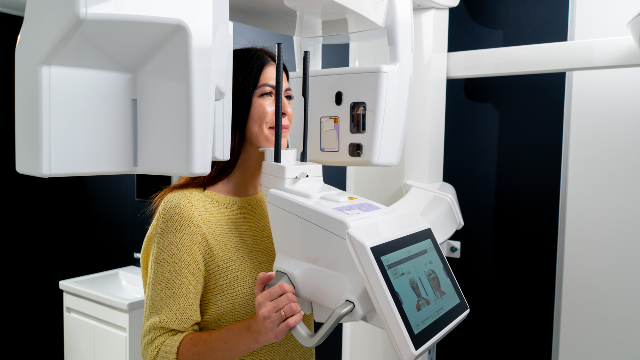
JNB Clinic's documented evaluation for revision work begins with the surgical history and moves through the current state of the nose: shape, breathing function, how much cartilage remains available, and the condition of the skin and soft tissue, with detailed anatomical analysis supported by 3D CT imaging. A revision plan is then drawn up for that specific nose.
Three findings carry particular weight.
Whether there is implant material in place. The clinic's described process includes removing or correcting problematic implants or tissue where that is necessary before anything is rebuilt. An implant that has contracted the tissue around it, moved, or caused persistent inflammation changes both the plan and the sequence.
Whether the airway is affected. Appearance and breathing are not separate files. Functional airway assessment is part of the clinic's revision workup, and correcting function is listed among the goals of the procedure alongside correcting shape.
How much donor cartilage is realistically available. This determines the technique. Where septal cartilage has been used up, JNB Clinic's rib cartilage approach exists precisely for cases requiring more structural material than the nose can still supply from inside itself.
What Reconstruction Actually Involves
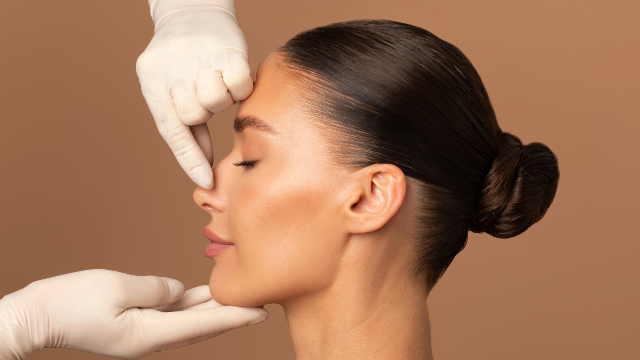
The clinic's described sequence for revision runs: consultation and review of the surgical history; structural and functional analysis of the nose; 3D CT evaluation where indicated; removal or correction of problem implants or tissue if needed; reconstruction using the patient's own cartilage; correction aimed at both function and appearance; and then postoperative care and recovery monitoring.
The rebuilding step is the substantive one. Rather than adding a manufactured implant on top of an already-compromised framework, the approach is to restore the framework itself from autologous tissue — restoring stability, proportion and long-term functional support, including in cases where an earlier implant caused the problem.
Where rib cartilage is used, the harvest is sorted by role before anything is placed. Solid segments go to load-bearing positions — the columellar pillar, the dorsum, the lateral framework — while cartilage diced finely is reserved for contour work at the tip and along the dorsal line. Revision and complex reconstruction are exactly the situations the clinic identifies this technique for.
Adjunctive measures may be part of the recovery plan rather than the surgery itself. The clinic lists hyperbaric oxygen therapy, LED therapy, PRP, IV therapy and scar management programs among the supports it uses, with regenerative adjuncts in selected cases.
Timing: Why Waiting Is Often Part of the Answer
Patients who are unhappy with a result frequently want the next operation booked immediately. That impulse is understandable and usually wrong.
Mayo Clinic's account of nasal surgery is the useful reference point here: by three to six months the tissues are likely to be somewhat stable, but cartilage and tissue can still move or change shape, and some changes continue for a year or more. Operating into tissue that is still settling means operating on a moving target — and makes it harder to tell which parts of the result are swelling and which are structure.
ASPS makes the related point about scar tissue and healing in general terms: wounds heal unpredictably. A revision planned once the tissue has declared itself is planned with better information.
The Limits Worth Hearing Before You Travel
A clinic that tells you everything is correctable is not being straight with you.
Some outcomes cannot be fully reversed. ASPS notes that nasal septal perforation is rare, that additional surgery may be needed to repair the septum, and that it may prove impossible to correct. Mayo Clinic lists continued symptoms after nasal surgery among the recognized risks, and notes that further surgery may be needed to address some of them, including when the expected result was not achieved.
Some cases need more extensive reconstruction than the patient was prepared for — a rib harvest rather than a small graft, a longer recovery, a staged approach. And a further operation carries its own full set of risks: anesthesia risk, infection, changes in skin sensation, difficulty breathing, poor wound healing or scarring, an unsatisfactory appearance, and the possibility of yet another revision.
JNB Clinic's own alternatives list includes observation where revision surgery is not immediately necessary. That option belongs in the conversation.
Recovery Expectations
For revision work specifically, the clinic states recovery generally takes around two to six months depending on how complex the surgery is and how the individual heals, with sutures typically removed around the seventh postoperative day. Structured follow-up continues afterward, and international patients are followed remotely once they are home.
The practical implication for anyone planning travel is that the trip covers the operation and the earliest phase of healing, not the result. The result arrives months later.
The Bottom Line
- Further correction after a failed revision elsewhere is often possible; JNB Clinic treats correction after prior nose surgery, including implant-related problems, as a defined part of its work.
- Candidacy depends on remaining cartilage, scar tissue, skin condition and airway status — assessed with 3D CT imaging and a full review of the surgical history.
- The approach rebuilds the framework with the patient's own cartilage, removing or correcting problem implant material first where that is needed.
- Waiting until the tissue has stabilized, generally several months to a year after the last surgery, usually produces a better-informed plan.
- Some problems cannot be fully corrected, some cases require more extensive reconstruction than expected, and a further operation carries its own risks.
Frequently Asked Questions
How long should I wait after my last operation?
Long enough for the tissue to settle. Mayo Clinic describes nasal tissues as somewhat stable by three to six months, with change still possible for a year or more. Your surgeon will weigh that against how urgent the specific problem is — a breathing obstruction or an exposed implant is not the same as dissatisfaction with a contour.
Does a third operation have a lower chance of success?
No responsible answer attaches a number to that. What is true is that each operation reduces the available cartilage and adds scar tissue, which is why the assessment focuses on what structure remains rather than on how many surgeries have gone before.
What if my septal cartilage is gone?
That is a common situation in revision cases and it is why rib cartilage exists as an option. JNB Clinic identifies its rib cartilage technique for patients with insufficient septal cartilage and for complex reconstruction and revision.
Can breathing problems from the first surgery be fixed too?
They are assessed as part of the same workup. Functional airway evaluation is built into the clinic's revision process, and functional correction is described alongside aesthetic correction rather than as a separate service.
Will the implant have to come out?
Not automatically, but removal or correction of problematic implants or tissue is part of the documented process when it is necessary. Whether it applies to you depends on what the imaging and examination show.
Can I be assessed before traveling to Korea?
An initial conversation can begin remotely, and the clinic supports English for international patients. The substantive assessment requires imaging and examination in person. You can start the process via the contact page.
Where can I read more about the clinic's approach?
Background on the practice is available on the about page, with documented outcomes in the before-and-after section.
Published for informational purposes and educational purposes, the above is not a self-diagnosis tool and cannot assess any individual nose; candidacy for further surgery must be decided in person by a qualified medical professional.
More Articles
Continue reading our clinical guides.

Benefits of Stem Cell Therapy for Skin Rejuvenation
Discover the benefits of stem cell therapy for skin rejuvenation, including improved texture, reduced wrinkles, and a more youthful appearance.
Learn More

Recovery After Autologous Cartilage Nose Surgery
Learn what to expect during recovery after autologous cartilage nose surgery, including healing timelines, aftercare tips, and results.
Learn More

Revision Rhinoplasty: Everything You Need to Know Before Your Second Nose Surgery
Revision Rhinoplasty: Learn what to expect from a second nose surgery, including risks, recovery, and results. Explore your options and learn more.
Learn More