Personalized Nasal & Facial Care • Dedicated International Patient Concierge

Medical Guide
Revision Rhinoplasty: Deciding on Regenerative Support
When is stem cell support discussed in revision rhinoplasty planning? The documented candidate, the timing question, and what the consultation settles.
Schedule a ConsultationWhen Is Stem Cell Support Recommended for Revision Rhinoplasty?
Medically reviewed by Dr. Kang Ju-Yong, Korean Board-Certified Otorhinolaryngologist (ENT Specialist)
Patients asking when stem cell therapy is recommended for revision rhinoplasty are usually asking a narrower question than they realize: not whether such an adjunct exists, but whether it has anything to do with their particular nose. JNB Clinic documents a regenerative adjunct as something considered alongside structural revision in a specific subset of cases, not as a routine addition to every second operation. This article sets out which cases that subset contains, why the timing of the discussion matters as much as the decision, and what a consultation has to establish before the question can be answered at all.
Why Second Operations Are a Different Problem
The reason an adjunct enters the conversation at all is that revision surgery starts from altered ground.
The American Society of Plastic Surgeons (ASPS), in a surgeon-authored account of corrective rhinoplasty, describes the central difficulty directly: the shape of the nose has already been changed by an earlier operation, which makes the second procedure technically more demanding and generally lengthens recovery. The same account notes that there is no fixed limit on how many times a nose can be operated on, but that every subsequent surgery tends to add scar tissue, and that scar tissue has a meaningful effect on both healing and the cosmetic result.
Two consequences follow. The first concerns material. ASPS observes that patients needing major correction are often treated as reconstructive cases, with a stable framework built from living tissue harvested elsewhere — the septum, the bowl of the ear, or a rib. Septal cartilage is regarded as the preferred material for that purpose, but some patients have had theirs used up entirely during the first operation, which is why other donor sites come into the plan.
The second concerns the envelope. Cartilage can be replaced from elsewhere in the body. The skin and soft tissue covering it cannot, and its condition after one or more previous surgeries is a fixed input to the plan rather than something the surgeon chooses.
That second consequence is the opening in which a regenerative adjunct is discussed.
The Documented Candidate
JNB Clinic's description of the patient for whom a regenerative adjunct is considered is specific enough to be checked against your own situation.
The clinic documents the candidate as a patient undergoing revision rhinoplasty who has compromised tissue quality, significant scarring, or soft-tissue deficits left by a prior nasal procedure, where regenerative support might be weighed alongside the structural correction itself. Elsewhere it describes the relevant group as patients needing tissue recovery and regeneration — particularly contracted noses, revision cases, and noses where skin and cartilage have become unstable following earlier surgery.
Its patient-facing answer widens the description slightly: people seeking correction after previous nose surgery because of scar tissue, contracture, thin or damaged nasal skin, implant-related problems, asymmetry, or tissue damage accumulated across multiple operations.
Read carefully, every item on that list is a statement about tissue condition rather than about aesthetics. Nobody is described as a candidate because they want a better-looking nose. They are described as candidates because the covering tissue has been compromised, and the structural plan has to account for that.
This is what makes the honest answer to "when" a narrow one. A first-time rhinoplasty patient with healthy skin does not appear anywhere in the documented description. Neither does a revision patient whose tissue came through the first operation intact.
The Timing Question Inside the "When"
There is a second sense of "when" that patients rarely anticipate, and it concerns sequence.
JNB Clinic's documented recovery pathway for revision rhinoplasty with a regenerative adjunct is staged rather than simultaneous. Where an implant needs to come out, that may come first. A period of regenerative treatment — described as roughly one to two months — may then precede the revision surgery itself, with postoperative recovery following, and the whole sequence depending on the patient's condition. Preparation for that pathway is described as a detailed consultation, review of the previous surgery, a medical history review, and planning of the structural correction, with instructions on medication, general health and avoiding smoking and alcohol.
Alongside this sits a timing constraint that applies to revision surgery generally. Mayo Clinic advises waiting at least a year before a follow-up nasal operation, because the nose continues to change during that period and most swelling has not resolved before then. Mayo also notes that it is difficult to state when a final result has been reached at all, since the nose changes throughout life with or without surgery.
Put together, those two points explain why the discussion about an adjunct is a planning conversation held months ahead rather than a decision made in the week before an operation.
The clinic's own recovery expectation for revision work is that healing generally runs about two to six months depending on the complexity of the correction and the individual, with sutures typically removed around the seventh postoperative day.
What the Consultation Has to Establish
JNB Clinic documents a comprehensive evaluation before any revision plan is made: a review of the previous surgeries, assessment of nasal shape and function, an inventory of what cartilage remains available, an assessment of the skin and soft tissue condition, and detailed anatomical analysis using 3D CT imaging. A personalized revision plan follows from that.
For the adjunct specifically, the consultation is described as assessing the structural and soft tissue status of the nose, determining whether revision surgery is needed at all, and then judging whether regenerative support may be useful alongside it.
The pathway for the clinic's regenerative service follows the same discipline: a one-to-one consultation covering concerns, medical history and goals; a detailed examination and diagnosis to decide whether the treatment is appropriate for that person; a personalized plan; the treatment carried out according to that plan; and aftercare with follow-up.
Notice the order. Suitability for the adjunct is decided after the structural question has been answered, not before it. A clinic that offers regenerative support before it has established what the surgery needs to do has reversed the sequence.
The clinic also documents when any such treatment should wait: pregnancy, an active skin infection in the area concerned, or not having completed a consultation confirming that the treatment is a fit. Dr. Kang Ju-Yong is a member of the Korean Society of Stem Cell Therapy; membership of a society is an affiliation and nothing more, and it is not a statement about whether a treatment will work for an individual patient.

Where the Evidence Conversation Belongs
ASPS's reporting on regenerative aesthetics supplies the framing that a patient should carry into this discussion, and its most useful sentence is about proportion.
In that account, the procedure itself remains the primary driver of the result, while regenerative products may support the healing environment around it. Applied to a nose, that is exactly the right ordering: the correction comes from the structural surgery, and anything added alongside is discussed in terms of the tissue environment rather than the shape.
ASPS also identifies fat grafting as among the most established regenerative applications in plastic surgery, used to improve tissue quality as well as restore volume, and specifically mentions thinned tissue and scarring as the settings where this is seen — the same two conditions that define the documented candidate above.
The cautions in the same reporting are equally worth carrying. ASPS notes that marketing in this area has in places moved faster than the evidence, and advises patients to ask what is actually in a product, how it is processed, and whether meaningful clinical data stands behind the claim being made. It advises seeking physician oversight before pursuing this kind of treatment, and seeking clinicians who are transparent about what is known, what is promising, and what remains investigational. It adds that the term itself does not automatically mean a treatment is more effective or more natural than an alternative.
A patient who asks those questions and receives a careful, bounded answer has learned something. A patient who receives enthusiasm has also learned something.
Questions to Bring to the Appointment
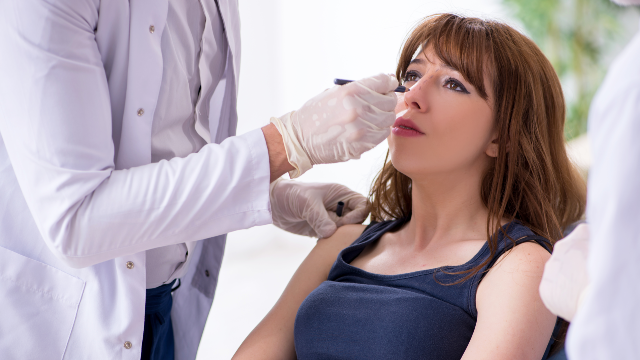
ASPS's checklist for any rhinoplasty consultation is the right backbone: come prepared to discuss your goals for both appearance and breathing, your medical conditions, drug allergies and previous treatments, your current medications and supplements, and your previous surgeries. Expect the surgeon to evaluate your general health, examine and measure the face, take photographs, and discuss likely outcomes along with risks and potential complications.
For a revision case with an adjunct under discussion, add four questions of your own. What specifically about my tissue puts me in the group you have described? What would the plan be if the adjunct were left out entirely? What is the sequence and how long is it? And how will we judge, afterwards, whether it made any difference?
ASPS lists the risks that remain present in any rhinoplasty regardless of what accompanies it: anesthesia risks, changes in skin sensation, difficulty breathing, infection, the rare possibility of septal perforation, poor healing or scarring, discoloration and swelling, an unsatisfactory nasal appearance, and the possibility of further revisional surgery. Those belong in the same conversation.
The clinic's about page describes its ENT-led, implant-free approach to structural revision, and individual questions are handled through the contact page.
The Bottom Line
- The documented candidate for regenerative support at JNB Clinic is defined by tissue condition — compromised tissue quality, significant scarring, or soft-tissue deficits from a prior nasal procedure — not by aesthetic goals.
- ASPS notes that a previously operated nose is technically more demanding to correct and that each further surgery tends to add scar tissue, which is why the covering tissue becomes part of the planning conversation.
- The clinic describes a staged sequence in which implant removal and roughly one to two months of regenerative treatment may precede the revision surgery, with the whole plan depending on individual condition.
- Mayo Clinic advises waiting at least a year before a follow-up nasal operation, since the nose continues to change and most swelling has not settled before then.
- ASPS advises asking what is in a preparation, how it is processed and what clinical data supports it, and notes that the procedure itself remains the primary driver of the result.
Frequently Asked Questions
Is this offered to every revision patient?
No. The clinic's documented description is confined to patients with compromised tissue quality, significant scarring or soft-tissue deficits from a previous nasal procedure. Suitability is decided individually after examination.
What decides whether I am in that group?
An assessment rather than a questionnaire. The clinic documents a review of previous surgeries, an evaluation of nasal shape and function, an inventory of remaining cartilage, assessment of skin and soft tissue condition, and anatomical analysis using 3D CT imaging.
Would it happen at the same time as my surgery?
Not necessarily. The clinic describes a sequence in which implant removal, where needed, and a period of roughly one to two months of regenerative treatment may come before the revision operation, followed by postoperative recovery.
How long should I wait after my first operation?
Mayo Clinic's guidance is at least a year before a follow-up procedure, because the nose keeps changing during that interval and most swelling has not resolved. Individual timing is confirmed at consultation.
What should I ask about the preparation itself?
ASPS suggests asking what is actually in it, how it is processed, and whether meaningful clinical data supports the specific claim being made, and advises seeking physician oversight and clinicians who distinguish the established from the investigational.
Does a society membership mean the treatment works?
No. A professional affiliation records participation in a field of study. It is not a statement about outcomes for an individual patient, and it should not be read as one.
What are the risks of the revision surgery itself?
ASPS lists anesthesia risks, altered skin sensation, breathing difficulty, infection, rare septal perforation, poor healing or scarring, discoloration and swelling, an unsatisfactory appearance, and the possibility of further surgery.
How long is recovery from revision rhinoplasty?
The clinic describes recovery as generally running about two to six months depending on complexity and the individual, with sutures typically removed around the seventh day after the operation.
Published for informational purposes and educational purposes only, this article is general background rather than advice and is not a self-diagnosis tool; whether any surgical plan or adjunct is appropriate in an individual case is determined by a qualified medical professional after examination.
More Articles
Continue reading our clinical guides.

Benefits of Stem Cell Therapy for Skin Rejuvenation
Discover the benefits of stem cell therapy for skin rejuvenation, including improved texture, reduced wrinkles, and a more youthful appearance.
Learn More

Recovery After Autologous Cartilage Nose Surgery
Learn what to expect during recovery after autologous cartilage nose surgery, including healing timelines, aftercare tips, and results.
Learn More

Revision Rhinoplasty: Everything You Need to Know Before Your Second Nose Surgery
Revision Rhinoplasty: Learn what to expect from a second nose surgery, including risks, recovery, and results. Explore your options and learn more.
Learn More