Personalized Nasal & Facial Care • Dedicated International Patient Concierge

Medical Guide
Male Rhinoplasty: Nasal Structure and Aesthetic Goals
Male rhinoplasty considerations: how skin thickness and nasal framework shape what surgery can deliver, what planning covers, and what to ask a surgeon.
Schedule a ConsultationMale Rhinoplasty: Structural Considerations and Aesthetic Goals
Medically reviewed by Dr. Kang Ju-Yong, Korean Board-Certified Otorhinolaryngologist (ENT Specialist)
Male rhinoplasty considerations begin with the same question as any nasal operation — what does this particular framework allow — but the answers often land in a different place. Men more frequently ask for a straighter profile rather than a softened one, for correction that does not read as a change of character, and for breathing to be addressed alongside appearance. Those goals are achievable in principle, but what any one nose can deliver is set by its own bone, cartilage and skin, not by a preference stated at consultation.
Covering and Framework: The Two Variables That Govern the Result
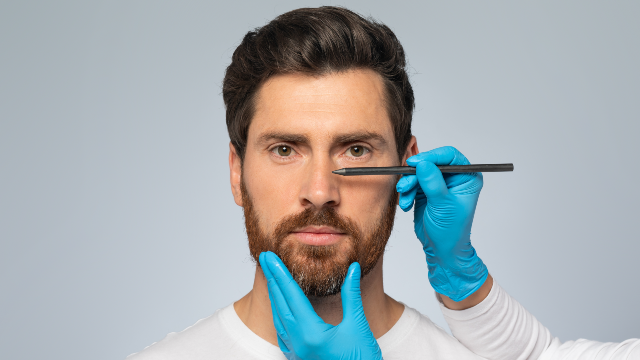
Every nose is a structural frame with a covering layer over it. Surgery alters the frame. The covering layer decides how much of that alteration shows.
The American Society of Plastic Surgeons (ASPS), writing about aesthetic procedures sought by men, makes the point directly: the procedures used to pursue goals such as a more balanced nose must take account of factors including skin thickness, beard growth and body type. Skin thickness appears on that list because it is the variable that most often separates what was drawn from what is visible afterwards.
Thicker soft tissue drapes over refinements rather than conforming tightly to them. Thinner covering shows everything the surgeon does — including anything slightly uneven. Neither is better. They simply call for different strategies, and the strategy has to be chosen after the skin has been assessed, not before.
JNB Clinic builds skin thickness into its assessment from the start. Its by-type rhinoplasty program analyzes the nose using high-resolution 3D scanning of facial contour, skin thickness and existing structure before a design is proposed. Its autologous cartilage program opens with a comprehensive assessment of the nasal bridge, tip, septum, cartilage quality, skin thickness and breathing function, with any previous rhinoplasty or filler history reviewed at the same time.
Why the Frame Matters More When the Covering Is Heavier
A frame that is going to be read through a thicker covering has to be built to do that work. Support is not decoration; it is what keeps a shape legible over time and under the weight of the tissue above it.
ASPS describes how surgeons source that support. Most commonly cartilage is taken from the septum, the partition in the middle of the nose. Occasionally cartilage from the ear is used, and rarely a section of rib cartilage. Whether material is removed or added depends on what the design requires.
JNB Clinic's position on material is specific. Its signature techniques are implant-free, reshaping or augmenting the nose entirely with the patient's own tissue — ear, rib or septal cartilage — rather than synthetic implants such as silicone or Gore-Tex, which the clinic describes as reducing risks including capsule contracture, chronic inflammation and implant displacement. Its non-implant rhinoplasty is summarized as closed rhinoplasty, 100 percent autologous cartilage, and functional as well as cosmetic correction.
The clinic also names the three in-house techniques within that family: KE-Co, an ear-cartilage approach for nano-structural refinement; Krib-Co, rib-cartilage full structural reconstruction; and KB-Co, a septal and ear cartilage hybrid performed through a closed approach with no external incisions. Technique selection is individualized after anatomical assessment, and donor sites — septum, ear or rib — are evaluated to determine which cartilage source fits the plan.
For a patient who wants a profile that holds its line, the practical question is not which technique sounds most advanced. It is which cartilage source the assessment supports, and what the surgeon says the design needs.
The Sub-Type Approach to Diagnosis
Rather than treating rhinoplasty as one operation with cosmetic variations, JNB Clinic diagnoses by nose-shape category and designs for the specific anatomical cause.
The clinic names six sub-types: a low nose with a flat or under-projected bridge between the eyes; a short or upturned nose that over-exposes the nostrils from the front; a hooked nose with a convex bump in the middle of the bridge; a long or drooping nose; a crooked nose leaning to one side, often with breathing difficulty; and a bulbous nose with a thick, widely spread tip. Which sub-type applies is confirmed by 3D facial scan during consultation, and the design is then built for that sub-type.
The documented corrections differ accordingly. For a hooked nose, the protruding hump is filed or cut and the bridge and tip are then refined together for a smooth line. For a long or drooping nose, where the alar cartilage is large or drooping, the drooping cartilage is resected and repositioned upward to lift the tip; where the septal cartilage is overdeveloped, the excess is removed and the downward droop corrected. For a crooked nose with severe deviation, both nasal bones are cut and realigned to the center, with lateral cartilage asymmetry corrected via septoplasty. For a bulbous tip, excess fat and muscle beneath the skin are removed, the splayed cartilage is bound and reinforced with autologous cartilage, and a graft may be added to refine and raise the tip.
Several of those are the concerns men most often bring to consultation — a dorsal hump, a deviated line, a wide tip — and the clinic's framing is useful precisely because it names the cause rather than the wish.
The clinic states that individual results vary and are not guaranteed, and its own guidance for this program is to avoid promising a specific measurement, symmetry outcome or degree of correction for any sub-type without individualized consultation.
Breathing Is Not a Separate Topic
Men presenting for nasal surgery often have a functional history — an old sports or accident injury, a long-standing blocked side, a septum that has never been straight. Treating appearance and airway as two separate projects is how patients end up having two operations.
ASPS includes correcting a deviated septum within its description of the rhinoplasty procedure: if the septum is deviated, it can be straightened and the projections inside the nose reduced to improve breathing.
JNB Clinic's stated philosophy, "Beauty that Breathes," holds that the nose is structural and functional as well as cosmetic, and that every procedure is designed with breathing, internal anatomy and long-term stability in mind alongside appearance. Its by-type program is documented as combining functional and aesthetic techniques to improve both nasal appearance and breathing, and sub-type corrections may be combined with functional correction — septoplasty for a crooked nose, for example — where breathing correction is needed.
Dr. Kang Ju-Yong is a licensed physician in South Korea and a board-certified Ear, Nose, and Throat specialist, with core specializations the clinic lists as implant-free rhinoplasty, revision rhinoplasty, functional rhinoplasty, closed scarless rhinoplasty and autologous cartilage rhinoplasty. The airway is not a bolt-on to that background; it is where it starts.
If breathing is part of the reason you are considering surgery, say so at the first consultation rather than treating it as a side note.
What the Consultation Should Cover
ASPS's guidance on planning aesthetic surgery as a male patient is blunt about the first requirement: good communication. In the initial consultation you will be asked to explain in detail why you want the procedure and how you hope to look and feel afterward, and ASPS advises setting aside any awkwardness and speaking candidly about the changes you want, so that you and the surgeon clearly understand one another.
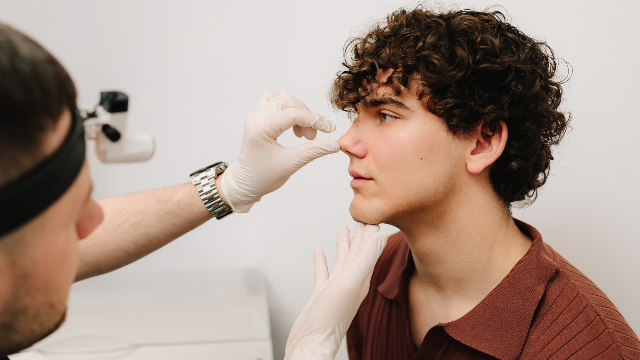
ASPS then describes what the surgeon does: evaluate your health, conduct a physical examination, take pre-operative photographs, and explain which surgical techniques are appropriate for you, along with the type of anesthesia, the facility, the possible risks and the costs.
Its closing point deserves repeating. Have realistic expectations — a surgeon can offer significant improvement, but not perfection — and bear in mind that age and health may play a role in the quality of the outcome.
JNB Clinic's documented consultation runs on similar lines, with 3D facial scanning and analysis of nose length, facial ratio and nasal line angle feeding an individualized design plan that is discussed with the patient before surgery. The clinic describes its design as accounting for facial proportion and harmony rather than height or shape alone.
Appointments and pre-travel questions are arranged through the clinic's contact page.
Preparation and the Shape of Recovery
ASPS lists the standard preparations: you may be asked to get a lab test, to take certain medications or adjust current ones, to stop smoking, and to avoid aspirin, anti-inflammatory drugs and herbal supplements because they can increase bleeding. Arrangements should be made for someone to drive you to and from surgery and to stay with you for at least the first night.
On the result, ASPS is clear that patience is required: initial swelling subsides within a few weeks, but it may take up to a year for the new nasal contour to fully refine, with gradual changes along the way.
JNB Clinic's post-surgery care for its autologous cartilage program runs across three scheduled appointments: the splint is taken off around the second day, alongside hyperbaric oxygen and LED care; sutures come out and relay care begins around day seven; and medical skin scaling with another hyperbaric oxygen session follows at two weeks. The clinic describes accompanying patients for up to a year after surgery. Patients traveling from overseas are advised to allow somewhere between seven and ten days in Korea before flying home, covering the follow-up appointments, splint care and recovery checks. Recovery is described as typically taking two to six months, with the nose becoming more stable and refined through healing.
Men planning around work should read that timeline honestly. The early phase is manageable; the final refinement is slow.
Questions Worth Asking
ASPS publishes a consultation checklist. The items that bear most on this topic: whether I am a good candidate, what is expected of me in order to reach a good result, which surgical technique is being recommended, how long recovery runs and what help I will need during it, which risks and complications attach to my own procedure, how complications are handled, how the nose can be expected to look as time passes, and what options exist if the cosmetic result disappoints me.
Two more are worth adding for a male patient specifically. What does my skin thickness mean for the amount of definition this plan can produce? And which parts of my request are limited by my own framework rather than by technique?
A surgeon willing to answer the second question in detail is telling you something useful. The clinic's about page describes how it approaches assessment and planning.
The Bottom Line
- ASPS notes that aesthetic procedures sought by men must take account of factors including skin thickness, beard growth and body type — skin thickness being the variable that most affects how much refinement shows.
- JNB Clinic assesses bridge, tip, septum, cartilage quality, skin thickness and breathing function before selecting a technique, using high-resolution 3D scanning.
- The clinic's approach is implant-free, using the patient's own septal, ear or rib cartilage, with three in-house techniques chosen after anatomical assessment.
- Diagnosis is by sub-type — low, short, hooked, long, crooked or bulbous — with the correction designed for the specific anatomical cause; the clinic states individual results vary and are not guaranteed.
- Breathing belongs in the same conversation as appearance; ASPS describes septal correction as part of the rhinoplasty procedure, and the clinic documents combining functional and aesthetic techniques.
Frequently Asked Questions
Is male rhinoplasty a different operation?
The surgical steps ASPS describes are the same — a closed or open approach, raising the covering tissue, reshaping the framework, redraping and closing. What differs is the planning: the goals stated, the framework being worked on, and the covering layer that will show or absorb the change.
How much does skin thickness really matter?
Enough that ASPS names it among the factors a plan must account for, and enough that JNB Clinic assesses it explicitly before technique selection. Thicker covering tends to soften fine definition; thinner covering shows more of the underlying work.
Can a dorsal hump be corrected without changing the rest of the profile?
The clinic's documented approach for a hooked nose files or cuts the hump and then refines the bridge and tip together for a smooth line, which treats the profile as one continuous line rather than a single point. What that produces in an individual case is decided at consultation.
Will my breathing be assessed?
The clinic's consultation for its autologous cartilage program includes breathing function alongside the structural assessment, and its by-type corrections may be combined with functional correction where needed. Raise any history of obstruction or injury early.
Are implants used?
The clinic describes its signature techniques as implant-free, using the patient's own ear, rib or septal cartilage rather than synthetic material such as silicone or Gore-Tex.
How long before the result settles?
ASPS states that swelling subsides within a few weeks but the contour may take up to a year to fully refine. The clinic describes recovery for its autologous cartilage program as typically two to six months, with follow-up continuing for up to a year.
How long should I stay in Korea?
The clinic advises international patients to allow approximately seven to ten days after autologous cartilage nose surgery for follow-up visits, splint care and recovery checks. Timing for an individual plan is confirmed with the clinic.
Prepared for informational purposes and educational purposes, this article offers general background rather than individual advice, is not a self-diagnosis tool, and does not replace the assessment a qualified medical professional makes in person.
More Articles
Continue reading our clinical guides.

Benefits of Stem Cell Therapy for Skin Rejuvenation
Discover the benefits of stem cell therapy for skin rejuvenation, including improved texture, reduced wrinkles, and a more youthful appearance.
Learn More

Recovery After Autologous Cartilage Nose Surgery
Learn what to expect during recovery after autologous cartilage nose surgery, including healing timelines, aftercare tips, and results.
Learn More

Revision Rhinoplasty: Everything You Need to Know Before Your Second Nose Surgery
Revision Rhinoplasty: Learn what to expect from a second nose surgery, including risks, recovery, and results. Explore your options and learn more.
Learn More