Personalized Nasal & Facial Care • Dedicated International Patient Concierge

Medical Guide
KE-Co vs. Krib-Co vs. KB-Co: Choosing the Right Autologous Rhinoplasty Technique
Compare KE-Co, Krib-Co, and KB-Co, the three implant-free autologous rhinoplasty techniques developed at JNB Clinic in Gangnam, Seoul, and how to choose.
Schedule a ConsultationKE-Co vs. Krib-Co vs. KB-Co: Choosing the Right Autologous Rhinoplasty Technique
Medically reviewed by Dr. Kang Ju-Yong, M.D., Board-Certified Otolaryngology (ENT) Specialist & Chief Director, JNB Clinic · Last updated July 2026
If you are trying to decide between KE-Co vs Krib-Co vs KB-Co, you are really asking a more practical question: which autologous rhinoplasty technique fits your nose, your goals, and your anatomy? These are the three named, implant-free rhinoplasty techniques developed in-house at JNB Clinic in Gangnam, Seoul, by Chief Director Dr. Kang Ju-Yong, a board-certified otolaryngology (ENT) specialist and rhinoplasty surgeon. Each one reshapes or rebuilds the nose using your own cartilage rather than a synthetic implant. This guide explains what makes each technique distinct, who each tends to suit, and how the choice is made, so you can walk into a consultation already understanding the language.

What "autologous" means and why JNB Clinic builds around it
"Autologous" simply means the graft material comes from your own body. At JNB Clinic, all three signature techniques belong to a family the clinic calls Autologous Cartilage Nose Surgery: a group of implant-free procedures that reshape or augment the nose entirely with your own tissue, taken from the ear, the septum, or a rib, rather than synthetic materials such as silicone or Gore-Tex. The clinic's stated reason for this approach is to reduce risks that can be associated with permanent artificial implants, including capsule contracture, chronic inflammation, and implant displacement.
This philosophy is captured in the clinic's tagline, "Beauty that Breathes." The idea is that a nose is not only a cosmetic feature but also a structural and functional organ, so every plan is designed to consider breathing, internal anatomy, and long-term stability alongside appearance. That framing matters when you compare techniques, because the "right" one is not simply the one that changes your profile the most. It is the one that matches how much structural support your nose actually needs.
Cartilage grafting itself is not unique to any single clinic. Mayo Clinic notes that during rhinoplasty, cartilage for smaller changes may be taken from deeper inside the nose or from the ear, while larger changes may draw on cartilage from a rib, other implants, or bone from elsewhere in the body. What JNB Clinic has done is organize those graft options into three defined techniques, each mapped to a different level of structural need. Understanding that spectrum, from gentle refinement to full reconstruction, is the key to reading the comparison below.
KE-Co (Keep Enchanting Nose): ear cartilage for natural tip refinement
KE-Co, short for "Keep Enchanting Nose," is JNB Clinic's ear cartilage rhinoplasty. It uses a small amount of your own ear cartilage to refine and support the nasal tip, and it is performed through a closed (endonasal) approach, meaning the incisions are made inside the nose and there is no visible external scar. According to the clinic, the technique relies on 100% of the patient's own cartilage to create natural-looking, stable results while considering both appearance and nasal function.
In practice, KE-Co is the most refinement-focused of the three. The clinic describes it as most suitable for patients who want a natural improvement using their own cartilage rather than an implant, particularly those with a low or flat nasal bridge, a droopy or under-projected nasal tip, or mild nasal asymmetry. It also suits healthy patients with realistic expectations who prefer a stable, natural result and want to preserve their breathing.
The procedure steps are straightforward to picture. After consultation and planning, the surgery is performed under appropriate anesthesia. Small incisions are made inside the nose, a small amount of ear cartilage is harvested and prepared, and that cartilage is used to refine and support the nose while preserving or improving breathing function. The incisions are then closed, and you enter the clinic's structured aftercare program.
Recovery, as the clinic describes it, is gradual. Most patients can return to light daily activities within about five to seven days after the splint is removed, while swelling and bruising continue to improve over the next two to four weeks. The nose typically looks more natural after the first month, but subtle swelling, especially around the tip, can take six to twelve months to fully resolve, with the final shape emerging over time. Because the result is built from your own cartilage, it is designed to be long-lasting and to age harmoniously.
It is worth knowing that KE-Co sits within a small family of related closed techniques the clinic references, including KE-BI-Co, which uses the patient's own septal cartilage, and KE-LIP-Co, which uses the patient's own rib cartilage for more extensive structural reconstruction. Compared with those, KE-Co is described as the simpler option that uses ear cartilage for targeted, natural contour enhancement.
Krib-Co: rib cartilage for full structural reconstruction
Krib-Co is JNB Clinic's rib cartilage rhinoplasty, and it sits at the opposite end of the structural spectrum from KE-Co. Where KE-Co refines, Krib-Co rebuilds. It uses your own rib cartilage to strengthen the nasal framework and enhance the shape of the nose, and the clinic positions it for patients who need stronger structural support than ear or septal cartilage alone can provide.
The candidacy language is specific. The clinic describes Krib-Co as potentially suitable for patients who require stronger structural support, who have insufficient septal cartilage to work with, who want an implant-free result using their own tissue, or who need complex nasal reconstruction or revision. In other words, this is the technique the clinic reaches for when a larger quantity of durable cartilage is needed, which is common in revision cases where earlier surgery has already used up available septal cartilage.
One of the more distinctive technical details JNB Clinic documents for Krib-Co is how the harvested rib is used. Rib cartilage is taken from the lower chest and then separated into two roles: structural cartilage, which supports the nasal pillar and columella, the bridge, and the lateral framework, and finely diced volume cartilage, which is used for shaping the tip and the dorsal line. That division lets a single technique both hold the nose up and smooth its surface contour.
The trade-offs are equally documented. The clinic's own comparison notes that rib cartilage offers strong, natural, long-term structural support with no risk of implant rejection, but it requires additional cartilage harvesting from the chest and generally a longer recovery period than the ear-cartilage approach. Mayo Clinic similarly notes that for larger changes in rhinoplasty, cartilage from a rib is one of the materials surgeons may use. As with every technique here, the surgical plan is individualized after assessing your nasal anatomy, functional needs, and aesthetic goals.
KB-Co: a septal and ear cartilage hybrid, with no external incisions
KB-Co is JNB Clinic's hybrid technique. It combines two cartilage sources, the patient's own septal cartilage and ear cartilage, in a single closed rhinoplasty that the clinic performs through what it calls a "nasal impact" technique with no external incisions. The logic behind the pairing is functional: septal cartilage tends to be firmer and is used for structural support, while ear cartilage is softer and is used for gentle tip refinement. The two together aim to reinforce the nasal framework, refine the tip, and produce a natural-looking result.
The clinic describes KB-Co as potentially suitable for patients who need natural reshaping with structural support, especially those with a weak or insufficient septal cartilage framework, those who want nasal tip refinement, or those with functional concerns such as breathing difficulty. Suitable candidates are described as having realistic goals and healthy nasal structures, with a plan customized to their anatomy.
KB-Co is also the technique for which the clinic publishes the most detailed risk information, which is useful when you are comparing options honestly. Documented possible risks include swelling, bruising, pain, infection, bleeding, temporary or persistent nasal blockage, changes in the sense of smell, asymmetry, graft displacement, warping or absorption of cartilage, contour irregularities, and the possibility of revision surgery. The clinic notes that because KB-Co uses your own septal and ear cartilage without artificial implants, it aims to reduce implant-related concerns, but cartilage healing and individual tissue responses can still affect results. That balance, real benefits alongside real risks, applies to any rhinoplasty, as both ASPS and Mayo Clinic emphasize.
Recovery follows the pattern you would expect from a cartilage-based, closed procedure. Initial swelling and bruising improve during the first one to two weeks, and patients generally return to daily activities as swelling decreases, while the nasal shape continues to refine over several months as the tissues settle.
How the three techniques compare at a glance
Reading the three side by side, a clear structure emerges:
- KE-Co (ear cartilage, closed): The refinement option. Best framed around tip definition and modest bridge support, with no external scar. Suited to lower-complexity goals where only a small volume of soft cartilage is needed.
- Krib-Co (rib cartilage): The reconstruction option. The choice when substantial, durable structural material is required, including complex or revision cases or when septal cartilage is insufficient. It offers strong long-term support at the cost of chest-donor harvesting and a longer recovery.
- KB-Co (septal + ear hybrid, closed): The middle-ground option. It combines firm septal support with soft ear-cartilage tip refinement through a no-external-incision approach, aiming to balance structure and finesse.
A helpful way to think about it is a spectrum of structural demand. If your nose mainly needs subtle tip work, the lightest technique may be enough. If it needs a full rebuild, the strongest option becomes relevant. KB-Co occupies the space in between. Importantly, none of these is presented as universally "better." The clinic's consistent message is that technique selection is individualized after anatomical assessment.
How JNB Clinic decides which technique fits you
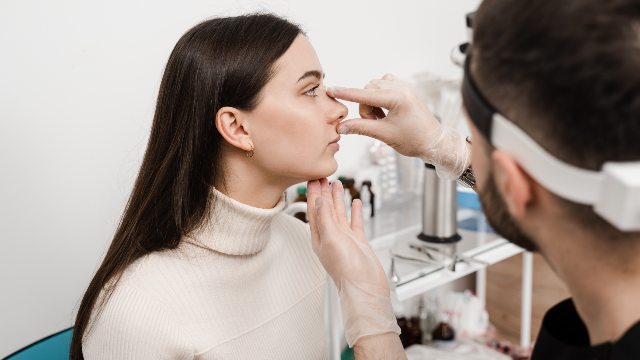
The decision is not made from a photo or a wish list alone. JNB Clinic's consultation process for autologous cartilage nose surgery includes a comprehensive assessment of the nasal bridge, tip, and septum, along with cartilage quality, skin thickness, and breathing function, and a review of any prior rhinoplasty or filler history. The clinic uses 3D-CT analysis to evaluate nasal structure precisely and to plan the surgery. International patients may complete an initial teleconsultation before traveling.
Because Dr. Kang is an ENT specialist, breathing is assessed alongside appearance rather than as an afterthought. Any of the three techniques can, when appropriate, be combined with functional procedures such as septoplasty to correct a deviated septum or turbinoplasty to improve airflow, so that aesthetic refinement and breathing improvement are addressed in one plan. ASPS notes that septoplasty, which straightens a deviated septum, is frequently combined with rhinoplasty, which reflects how closely form and function are linked in nasal surgery.
The overall pathway is consistent across techniques: anatomical and breathing assessment, technique selection and a personalized surgical plan, surgery under appropriate anesthesia, entry into the JNB Signature Post-Surgery Care program, and long-term follow-up for up to one year. That aftercare program unfolds in phases, beginning with splint removal and supportive care in the first days, suture removal around day seven, and further recovery care at roughly two weeks. International patients are generally advised to plan a stay in Korea of about one to two weeks, with the exact timeline confirmed directly with the clinic based on the technique used.
You can review the surgeon's background and the clinic's approach on the JNB Clinic About Us page, and you can see technique-labeled results in the before-and-after gallery to understand what each approach looks like in practice.
The Bottom Line
- KE-Co, Krib-Co, and KB-Co are three implant-free rhinoplasty techniques developed in-house at JNB Clinic by Dr. Kang Ju-Yong, each mapped to a different level of structural need.
- KE-Co uses ear cartilage through a closed approach for natural tip refinement; Krib-Co uses rib cartilage for full structural reconstruction; KB-Co is a septal-and-ear hybrid performed with no external incisions.
- The right technique depends on your anatomy, not a fixed ranking; selection follows a detailed assessment that includes 3D-CT analysis and a breathing evaluation.
- All three avoid synthetic implants to reduce implant-related concerns, but every rhinoplasty carries real risks and no result is guaranteed.
- Because Dr. Kang is an ENT specialist, function and appearance are planned together, and functional procedures can be combined when needed.
Frequently Asked Questions
How do I choose between KE-Co, Krib-Co, and KB-Co?You do not choose alone. The technique is selected after an in-person or virtual assessment of your nasal structure, cartilage quality, skin thickness, and breathing, supported by 3D-CT imaging. As a general pattern, refinement-focused goals may point toward KE-Co, complex or revision cases toward Krib-Co, and hybrid structure-and-tip goals toward KB-Co.
Are these techniques really implant-free?Yes. All three belong to JNB Clinic's Autologous Cartilage Nose Surgery family, which reshapes or augments the nose using your own ear, septal, or rib cartilage rather than synthetic implants such as silicone or Gore-Tex.
Which technique leaves no external scar?Both KE-Co and KB-Co are performed through closed (endonasal) approaches with no external incisions. Krib-Co involves harvesting cartilage from the lower chest, which is a separate donor site.
Is one technique safer than the others?The clinic does not present any single technique as universally safest. All rhinoplasty carries risks such as bleeding, infection, swelling, asymmetry, and the possibility of revision, as Mayo Clinic and ASPS both note. Using your own cartilage is intended to reduce implant-related concerns, but healing responses still vary by person.
Why is an ENT specialist performing cosmetic nose surgery?Dr. Kang Ju-Yong is a board-certified otolaryngology (ENT) specialist and rhinoplasty surgeon, not a board-certified plastic surgeon. Mayo Clinic notes that rhinoplasty is commonly performed by plastic surgeons, facial plastic surgeons, or otolaryngologists (ENTs), and that experience with the procedure matters when choosing a surgeon.
How long will results last?Because the techniques use your own cartilage, the clinic designs them for long-lasting, stable results. That said, Mayo Clinic points out that the nose continues to change throughout life whether or not you have surgery, and individual results vary.
Can these be combined with breathing surgery?Yes. Any of the three can be combined with functional procedures such as septoplasty for a deviated septum or turbinoplasty for airflow when appropriate, so breathing and appearance are addressed together.
This article is for general informational purposes and does not constitute individualized medical advice. Rhinoplasty outcomes vary from person to person, and no specific result is guaranteed. Please consult a qualified surgeon about your own anatomy and goals. To discuss your options or arrange a consultation, contact JNB Clinic.
More Articles
Continue reading our clinical guides.

Benefits of Stem Cell Therapy for Skin Rejuvenation
Discover the benefits of stem cell therapy for skin rejuvenation, including improved texture, reduced wrinkles, and a more youthful appearance.
Learn More

Recovery After Autologous Cartilage Nose Surgery
Learn what to expect during recovery after autologous cartilage nose surgery, including healing timelines, aftercare tips, and results.
Learn More

Revision Rhinoplasty: Everything You Need to Know Before Your Second Nose Surgery
Revision Rhinoplasty: Learn what to expect from a second nose surgery, including risks, recovery, and results. Explore your options and learn more.
Learn More