Personalized Nasal & Facial Care • Dedicated International Patient Concierge

Medical Guide
How Soon Can I Fly Home After Rhinoplasty Surgery?
How soon can I fly after rhinoplasty? The published waiting advice, why cabin conditions matter, and what has to be finished before you board a plane.
Schedule a ConsultationHow Soon Can I Fly Home After Rhinoplasty Surgery?
Medically reviewed by Dr. Kang Ju-Yong, Korean Board-Certified Otorhinolaryngologist (ENT Specialist)
How soon can I fly after rhinoplasty is usually the second question an international patient asks, right behind what the surgery will cost them in time. The published answer sits in a narrow band: the Centers for Disease Control and Prevention, in its Yellow Book chapter on medical tourism, relays an American Society of Plastic Surgeons recommendation that patients wait seven to ten days following a cosmetic procedure on the face, eyelids or nose before boarding a flight. JNB Clinic's own guidance for patients traveling from abroad points to a comparable window on the ground in Korea. The date is still confirmed case by case, not booked in advance.
The Published Window, and Where It Comes From
Two separate figures get confused in travel forums, so it is worth separating them.
The CDC gives a flat instruction for one category of operation: patients should not fly for ten days after chest or abdominal surgery, because of the pressure changes involved. Nasal and facial work is handled differently. There, the CDC passes along the ASPS recommendation of a seven-to-ten-day interval after laser treatments or cosmetic procedures of the face, eyelids or nose.
That is a recommendation about a procedure category, not a clearance for your particular nose. It tells you how to shape a return booking. It does not replace the surgeon's assessment at your last follow-up visit, which is the only thing that actually releases you to travel.
Why a Waiting Period Exists at All
The reasons are circulatory, not cosmetic.
The CDC's position is that an operation and a long flight each raise clot risk on their own, and that flying soon after surgery stacks one on the other, because the traveler stays seated for hours while the blood is already more prone to clotting. Its air travel chapter puts a number on the baseline: across flights longer than four hours, roughly one in 4,600 results in symptomatic venous thromboembolism within the following month, with recent surgery named among the factors that push an individual above that baseline.
The Aerospace Medical Association, as cited by the CDC, recommends that chronic conditions and instabilities be evaluated before travel in people who have had recent surgery, among other groups. The CDC repeats the point plainly for anyone who has recently had an operation: speak to your physician before flying.
None of that makes flying after nose surgery dangerous in some categorical way. It makes the timing a medical decision rather than a scheduling preference.
What a Pressurized Cabin Does to a Healing Nose
A second set of reasons is local to the nose itself, and these are the ones patients tend not to anticipate.
Commercial cabins are held at a pressure equivalent to roughly 6,000 to 8,000 feet of altitude. When pressure changes quickly during climb and descent, air trapped in the middle ear and the sinuses has to equalize through the eustachian tube. If that tube is blocked, the result is barotrauma — usually a brief, unpleasant pressure pain, occasionally something worse. The CDC notes that travelers with ear, nose and sinus infections or heavy congestion may prefer to postpone a flight rather than fly through it.
Congestion is exactly what a recently operated nose produces. Mayo Clinic describes the nose feeling stuffed up after rhinoplasty, both from swelling and from the splints placed inside it. Cabin air compounds the dryness: the CDC puts typical cabin humidity at 10 to 20 percent, which dries the mucous membranes of the upper airway.
So the waiting period is not only about clots. It is also about not asking a swollen, splinted, congested nose to equalize pressure twice in one day.
What Has to Be Finished Before You Go
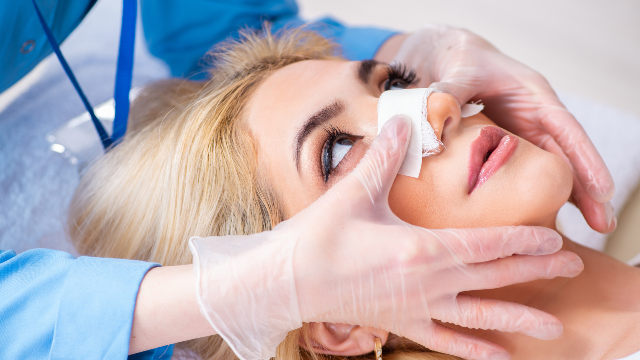
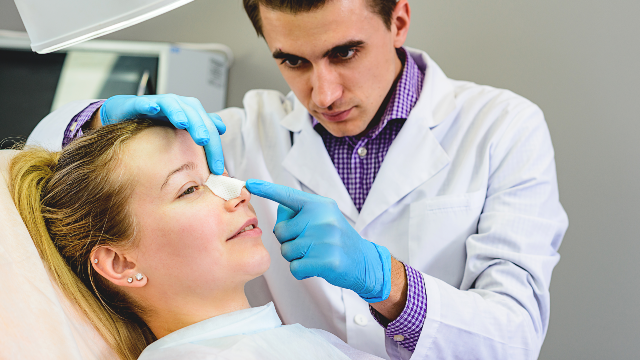
At JNB Clinic, the first two weeks after signature rhinoplasty are structured rather than open-ended, and the early appointments are the reason the stay has a minimum length.
The clinic's post-surgery care program runs in three phases. Around day two, the splint comes off and the patient receives hyperbaric oxygen therapy and Smart LED care. Around day seven, sutures are removed and relay care is given. At roughly the two-week mark there is medical skin scaling and a further hyperbaric oxygen session. For patients traveling internationally, the clinic advises planning on approximately seven to ten days in Korea after surgery so that follow-up visits, splint care and recovery checks are completed before the journey home.
Care does not stop at the airport. JNB Clinic continues structured remote follow-up once international patients have returned home, and its signature rhinoplasty program extends up to a year after surgery. Scheduling, including the timing of those final in-person checks, is arranged through the clinic's contact page.
Flying Is Not the End of Swelling
Patients sometimes read the flight date as the finish line. It is closer to the midpoint.
ASPS describes initial swelling settling over a few weeks, with the nasal contour continuing to refine for as long as a year; swelling may come and go, and is often worse in the morning during that first year. Mayo Clinic's account matches: short-term swelling or discoloration around the eyelids for two to three weeks, swelling of the nose itself lasting considerably longer, and most of it resolved within a year.
Mayo also lists restrictions that outlast the flight. Avoid strenuous activity such as jogging and aerobics for several weeks. Do not blow your nose. Sneeze and cough with the mouth open. Do not rest eyeglasses or sunglasses on the nose for at least four weeks, using cheek rests or taping them to the forehead instead. Use SPF 30 sunscreen outdoors, since too much sun can leave lasting discoloration on nasal skin.
Those instructions travel with you. A return flight that happens on schedule and a recovery that is still underway are perfectly compatible.
Making the Flight Itself Easier
Once a date is cleared, a few measures are worth building into the booking.
The CDC relays the American College of Chest Physicians' advice for longer flights: choose an aisle seat, get up and walk often, and do calf muscle exercises while seated. People with known risk factors may benefit from properly fitted graduated compression stockings delivering 15 to 30 mmHg at the ankle. The same guidance notes that aspirin has not been shown to reduce the risk.
Two further CDC recommendations are specific to having had treatment abroad. Ask for copies of your medical records in English and give them to whoever treats you afterward. And arrange, before you leave, for a clinician at home who is willing to provide follow-up or emergency care once you are back.
When the Date Should Move
Some situations argue for staying longer rather than flying on the earliest permitted day.
More extensive structural work, a complicated early recovery, persistent bleeding or drainage, signs of infection, or a personal or family history of clotting all belong in the conversation before a ticket is confirmed. The CDC is emphatic on one related point: if you suspect a complication, during travel or after getting home, do not delay seeking care, because earlier diagnosis leads to a better outcome.
Booking a flexible return fare costs less than rebooking a fixed one.
The Bottom Line
- The CDC relays an ASPS recommendation to wait seven to ten days after a cosmetic procedure of the face, eyelids or nose before flying; a separate ten-day rule applies to chest or abdominal surgery.
- Surgery and air travel each raise clot risk independently, and flying soon after an operation combines the two while the traveler sits still for hours.
- Cabin pressure changes and 10 to 20 percent humidity are hard on a nose that is swollen, splinted and congested.
- JNB Clinic advises international patients to plan on roughly seven to ten days in Korea after surgery to complete splint removal, suture removal and recovery checks.
- The actual clearance comes from the surgeon at follow-up, not from a published interval, and swelling continues to settle for months after the flight home.
Frequently Asked Questions
Is seven days ever enough after nose surgery?
It falls at the bottom of the published range rather than outside it, and it assumes an uncomplicated course. JNB Clinic's schedule puts suture removal at around day seven, so the earliest realistic departure is immediately after that appointment, with the surgeon's agreement.
Does the length of the flight change the advice?
The CDC's clot data is drawn from flights of more than four hours, and it notes that risk rises with duration. A long-haul return therefore deserves more caution about seat choice, movement and hydration than a short hop, even when the same waiting interval applies.
Will my ears hurt on the plane?
Possibly, if the nose is still congested. Pressure equalization depends on the eustachian tube, and the CDC notes that heavy congestion is a reason some travelers postpone flying. Discuss any decongestant use with the clinic rather than self-treating after nasal surgery.
Can I fly with the splint still on?
That is a question for the operating surgeon. At JNB Clinic the external splint is addressed at the first scheduled visit, around day two, well before the recommended travel window opens.
What if my swelling looks worse after the flight?
Swelling fluctuating is normal in itself — ASPS notes it can come and go and is often worst in the morning through the first year. What is not routine is new pain, fever, bleeding or spreading redness. The CDC's advice in that case is to seek care promptly rather than wait.
Can I be followed up after I get home?
Yes. The clinic provides structured remote follow-up for international patients after they return, alongside the local physician the CDC recommends identifying in advance. The two are complementary, not interchangeable.
How do I confirm my own date?
Through the clinic, after examination. Timing depends on the technique used and how the individual recovery is progressing. You can read more about how the practice works on its about page and raise travel timing directly through its contact channel.
Shared for informational purposes and educational purposes, this article is general information and not a self-diagnosis tool; clearance to fly after nasal surgery is given by the operating medical professional after examination, and no published interval replaces that judgment.
More Articles
Continue reading our clinical guides.

Benefits of Stem Cell Therapy for Skin Rejuvenation
Discover the benefits of stem cell therapy for skin rejuvenation, including improved texture, reduced wrinkles, and a more youthful appearance.
Learn More

Recovery After Autologous Cartilage Nose Surgery
Learn what to expect during recovery after autologous cartilage nose surgery, including healing timelines, aftercare tips, and results.
Learn More

Revision Rhinoplasty: Everything You Need to Know Before Your Second Nose Surgery
Revision Rhinoplasty: Learn what to expect from a second nose surgery, including risks, recovery, and results. Explore your options and learn more.
Learn More