Personalized Nasal & Facial Care • Dedicated International Patient Concierge

Medical Guide
First-Time vs. Revision Rhinoplasty: Planning Needs
First-time vs revision rhinoplasty planning: what each consultation establishes, how imaging and cartilage assessment differ, and how expectations diverge.
Schedule a ConsultationFirst-Time vs. Revision Rhinoplasty Patients: Different Planning Needs
Medically reviewed by Dr. Kang Ju-Yong, Korean Board-Certified Otorhinolaryngologist (ENT Specialist)
First-time vs revision rhinoplasty planning differs less in the operating room than in everything that precedes it. A first-time patient and a revision patient may want a similar-looking nose, but the surgeon preparing each plan is answering different questions, working from different starting information, and accounting for different unknowns. Understanding which group you are in changes what you should expect from a consultation, how much assessment is reasonable before anything is scheduled, and how to read the answers you are given.
The Same Procedure Name, Two Different Information Problems
A primary case begins with anatomy that has never been altered surgically. Whatever is found at operation is what nature put there, and the surgeon's task is to plan a change to a known starting point.
A revision case begins with anatomy that has already been changed, by someone else, in ways that are only partly documented. Scar tissue has formed. Cartilage may have been removed, repositioned or replaced. Support that was present at birth may no longer be there. The operative report, where one exists, describes intentions rather than everything that occurred.
Mayo Clinic's characterization of rhinoplasty is worth holding in mind for both groups. It calls the operation a difficult one, for concrete reasons: the nose is a complicated three-dimensional shape sitting in the middle of the face, the alterations made are often measured in millimeters, and that smallness leaves correspondingly little room for error. Mayo also notes that rhinoplasty has no fixed sequence of steps — surgeons personalize each operation to the individual patient.
That personalization requirement is real in a primary case. In a revision case it is the entire job.
What a First-Time Consultation Is Establishing
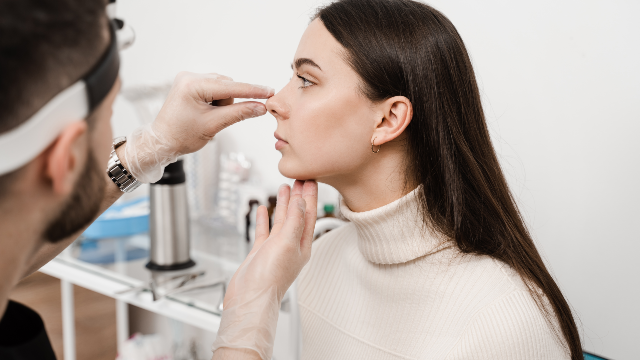
For a patient who has never had nasal surgery, the consultation is building a complete picture from scratch.
ASPS sets the agenda: come prepared to discuss your surgical goals with respect to both appearance and breathing, your medical conditions, drug allergies and previous treatments, your current medications, supplements, alcohol and tobacco use, and any previous surgery. Expect the surgeon to assess general health and risk factors, examine and measure the face, take photographs, discuss the options available for reshaping and the likely outcomes, and set out the risks.
JNB Clinic's primary assessment maps onto that. For its autologous cartilage program, the opening consultation looks at bridge and tip, at the septum, at how sound the cartilage is, at skin thickness and at breathing, and it reviews whatever rhinoplasty or filler came before. Technique selection follows the anatomical assessment rather than preceding it, and donor sites — septum, ear or rib — are evaluated to determine which cartilage source fits the plan. Patients abroad may complete this step by teleconsultation before traveling.
Mayo Clinic adds one element patients rarely anticipate: the surgeon looks at the proportions of the whole face and profile, and may raise chin projection, because a small chin can make a nose look larger than it is. Chin surgery is not required, but the observation illustrates that a primary plan is a plan about a face, not only about a nose.
What a Revision Consultation Adds
The revision consultation covers all of the above and then takes on a second body of work: reconstructing what happened last time.
JNB Clinic's revision evaluation is described as comprehensive, covering review of the previous surgeries, assessment of nasal shape and function, cartilage availability, the condition of the skin and soft tissue, and detailed anatomical analysis using 3D CT imaging. A personalized revision plan is developed from those findings.
Two items on that list have no counterpart in a primary case. Cartilage availability is a question about what remains after an earlier operation consumed some of it. Skin and soft tissue condition is a question about what previous surgery and subsequent healing have done to the covering layer.
The clinic's own position on candidacy reflects that added complexity. Suitability for revision is determined through a comprehensive consultation rather than against a fixed list of exclusions, with the surgeon weighing nasal anatomy, previous surgical history, available cartilage, functional concerns, overall health and aesthetic goals to decide whether revision is appropriate now or should wait until conditions are better.
A first-time patient is usually told what can be done. A revision patient should expect to be told what can be established first.
Cartilage: An Open Question Versus a Counted Resource
Mayo Clinic describes how material is selected in nasal surgery. For small changes, cartilage may be taken from deeper inside the nose or from the ear. For larger changes, cartilage from a rib, implants, or bone from elsewhere in the body may be used. The choice depends on how much needs to be removed or added, on the nose's structure, and on what material is available.
For a first-time patient, that last clause is rarely a constraint. The septum is usually intact, the ear is untouched, and the decision is driven by what the design requires.
For a revision patient, availability is the constraint, and it is assessed explicitly. JNB Clinic lists autologous rib cartilage rhinoplasty, nose tip reconstruction, alar base reduction and implant removal among the procedures that may be combined with revision surgery as the patient's anatomy and revision needs require. The clinic's broader position is implant-free: its signature techniques reshape the nose using the patient's own ear, septal or rib cartilage rather than synthetic material, and its revision work is described in the same terms — structural correction using autologous cartilage to restore stability, proportion and long-term functional support.
The planning consequence is straightforward. In a primary case, cartilage source is a design decision. In a revision case, it is a logistics decision that the design has to accommodate.
Filler History Belongs in the First-Time Conversation Too
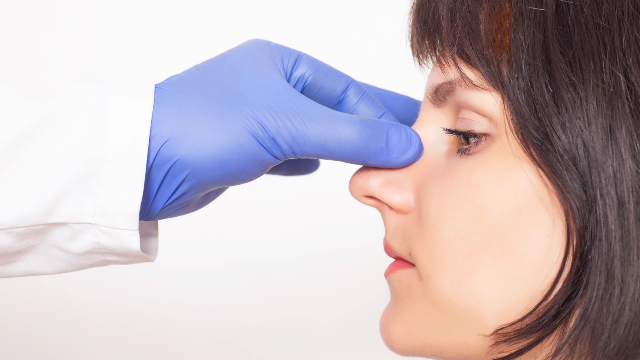
One category sits between the two groups: patients who have never had surgery but have had injectable filler in the nose.
JNB Clinic treats this as a preparatory step rather than a detail. It offers filler removal for patients who previously received nose filler and are planning rhinoplasty, on the basis that removing residual material allows accurate assessment of the underlying structure and more predictable planning. The consultation for it covers filler history, current nose shape, identification of remaining material, and the condition of skin and soft tissue, with reassessment of the natural nasal structure before the surgical plan is finalized. The clinic positions this as a necessary preparatory step for patients with prior injections, not as a standalone cosmetic treatment.
Patients in this position should say so at the first consultation, with dates and products if they have them. It changes the assessment sequence.
Timing Works Differently
For a first-time patient, timing is largely a matter of convenience, health status and preparation. For a revision patient, timing is clinical.
Mayo Clinic is explicit about the interval before further surgery: twelve months is the stated minimum before a follow-up operation, since the nose goes on altering across that stretch of time. Mayo makes a related point about why a second operation is sometimes discussed at all — very small changes make a large visible difference, and occasionally the changes achieved are not enough.
JNB Clinic's revision position includes the possibility of postponement until conditions are optimal, and in cases where regenerative support is part of the plan, its published material describes a sequence that may involve implant removal, followed by roughly one to two months of regenerative therapy before the revision surgery itself, then postoperative recovery, depending on the patient's condition.
A first-time patient books around their calendar. A revision patient should expect the calendar to be set by tissue.
Expectations Are Calibrated Differently
ASPS's criteria for a good rhinoplasty candidate apply to both groups: completed facial growth, physical health, nonsmoking status, and a positive outlook with realistic goals for the improvement sought. The word doing the work there is realistic, and it means something different in each case.
A first-time patient is calibrating against their own unoperated anatomy — what this framework and this skin can be shaped into. Mayo Clinic describes that discussion as a review of what rhinoplasty can and cannot do, supported by photographs from several angles and sometimes by simulations, with the surgeon explicitly reviewing the limits.
A revision patient is calibrating against a nose that has already been operated on, with a tissue bed that has already healed once. JNB Clinic describes the potential benefits of revision in terms of correcting previous surgical problems, restoring nasal support, improving breathing function and improving symmetry and facial harmony — a vocabulary of restoration and correction rather than of starting fresh. The clinic states plainly that individual results vary and are not guaranteed.
Both groups should expect their surgeon to describe limits. A revision patient should be more suspicious if no limits are mentioned at all.
The Practical Arrangements Diverge
Logistics follow the same pattern as everything else: broadly similar, with the revision case carrying more variables.
JNB Clinic advises international patients to plan on approximately seven to ten days in Korea after autologous cartilage nose surgery, covering follow-up visits, splint care and recovery checks before traveling home. Its structured post-surgery program runs in three scheduled phases through the first two weeks, and the clinic continues following patients for up to a year, with remote follow-up after international patients return home.
For revision specifically, the clinic states that recovery generally takes approximately two to six months depending on the complexity of the surgery and the individual's healing, with suture removal typically around the seventh postoperative day. The aftercare framework is the same as for its other rhinoplasty work, including remote follow-up once the patient is home.
Two CDC recommendations apply to either group traveling for surgery. Ask for your medical records in English, and hand them over to whoever treats you later. And line up, before departure, a doctor in your own community prepared to take on follow-up or urgent care once you are back. For a revision patient, the first of those is doubly relevant: the records from the earlier operation are exactly the documentation the new surgeon wants.
Scheduling and document questions are handled through the clinic's contact page.
What Each Group Should Ask
For a first-time patient: what does my skin thickness and cartilage quality mean for the design being proposed? Which cartilage source is planned, and why that one? Was my breathing assessed, and what did it show? What will the nose look like at one month, three months and a year? What are the risks specific to my case?
For a revision patient: what does the imaging show about the cartilage I still have? What is the condition of my skin and soft tissue? Which parts of the previous surgery can be corrected and which cannot? Is there a reason to wait before operating? What preparation, if any, comes before the surgery itself?
The about page sets out how the practice approaches assessment for both.
The Bottom Line
- A primary plan starts from unaltered anatomy; a revision plan starts from anatomy already changed by an earlier operation and only partly documented.
- JNB Clinic's revision evaluation adds cartilage availability and the condition of skin and soft tissue to the assessment, with 3D CT imaging used for detailed anatomical analysis.
- Mayo Clinic describes cartilage source as driven by how much is being changed and what material is available — a design choice in a primary case, a constraint in a revision.
- Timing is clinical rather than convenient for revision patients; Mayo advises at least a year before further surgery, and the clinic may recommend postponement until conditions are better.
- Both groups need realistic goals, but the reference point differs: unoperated anatomy in one case, a previously operated nose in the other.
Frequently Asked Questions
Why does a revision consultation take longer?
Because it covers two subjects rather than one. Alongside the usual assessment of goals, health and anatomy, JNB Clinic's revision evaluation reviews the previous surgeries, the cartilage still available and the condition of the skin and soft tissue, supported by 3D CT imaging.
Is imaging used for first-time patients as well?
Yes. 3D-CT analysis and high-resolution 3D facial scanning are part of the clinic's planning for its autologous cartilage and by-type rhinoplasty programs, not only for revision cases. What differs is how much of the imaging is devoted to reconstructing a previous operation.
What if I do not have records from my first surgery?
Bring whatever exists and expect the assessment to rely more heavily on examination and imaging. The CDC separately advises every patient treated abroad to request copies of their records in English, which is worth doing at the time rather than years later.
Does having had filler mean I am a revision patient?
Not in the surgical sense, but it does change the preparation. JNB Clinic offers filler removal before rhinoplasty so that the underlying structure can be assessed accurately, and treats it as a preparatory step rather than a standalone treatment.
Is recovery longer after a revision?
The clinic states that revision recovery generally takes approximately two to six months depending on the complexity of the surgery and the individual's healing, with suture removal typically around day seven. ASPS notes that for rhinoplasty in general, the contour continues refining for up to a year.
How long should I plan to stay in Korea?
JNB Clinic advises international patients to allow roughly seven to ten days after autologous cartilage nose surgery for follow-up visits, splint care and recovery checks. Timing for an individual case, including revision work, is confirmed with the clinic.
Can I be assessed before I travel?
International patients may complete the initial consultation step remotely before traveling, and the clinic supports English communication and online consultation where appropriate. An in-person examination and imaging still precede any surgical plan being finalized.
Shared for informational purposes and educational purposes, this article is general information and not a self-diagnosis tool; whether a first-time or revision procedure is appropriate, and what it can achieve, is determined by a qualified medical professional after examination and imaging.
More Articles
Continue reading our clinical guides.

Benefits of Stem Cell Therapy for Skin Rejuvenation
Discover the benefits of stem cell therapy for skin rejuvenation, including improved texture, reduced wrinkles, and a more youthful appearance.
Learn More

Recovery After Autologous Cartilage Nose Surgery
Learn what to expect during recovery after autologous cartilage nose surgery, including healing timelines, aftercare tips, and results.
Learn More

Revision Rhinoplasty: Everything You Need to Know Before Your Second Nose Surgery
Revision Rhinoplasty: Learn what to expect from a second nose surgery, including risks, recovery, and results. Explore your options and learn more.
Learn More