Personalized Nasal & Facial Care • Dedicated International Patient Concierge

Medical Guide
A Rhinoplasty Consultation at JNB Clinic: What Happens
What happens in a rhinoplasty consultation at JNB Clinic in Seoul: history, nasal exam, 3D CT imaging, cartilage planning, and the questions worth asking.
Schedule a ConsultationA Rhinoplasty Consultation with Dr. Kang Ju-Yong: What Actually Happens
Medically reviewed by Dr. Kang Ju-Yong, Korean Board-Certified Otorhinolaryngologist (ENT Specialist)
Patients searching for what happens rhinoplasty consultation appointments involve are usually trying to work out one thing: whether the visit is a sales meeting or a medical assessment. At JNB Clinic the documented sequence is diagnostic — history, physical examination of the nose inside and out, three-dimensional imaging, an assessment of which of your own cartilage sources could be used, and only then a surgical design. This article walks through that sequence in order, so you arrive knowing what is coming and can spend the time on your own anatomy.
Before You Arrive: The Remote Step
For patients outside Korea, the first contact usually is not in Seoul.
JNB Clinic's documented process allows international patients to complete an initial consultation remotely before traveling, and its functional nasal surgery pathway likewise begins, where appropriate, with a remote teleconsultation. The clinic's official site is published in English as well as Korean, and enquiries, consultation requests, and appointment coordination run through the channels listed on its contact page.
Use that first exchange for the things that do not require an examination: what you dislike about your nose, whether you have had nasal surgery or filler before, whether you have breathing symptoms, and what your travel window looks like. The anatomy cannot be settled remotely. The agenda can.
Step One: History
Every documented consultation pathway at the clinic opens with history rather than with a mirror.
For the autologous cartilage procedures, prior rhinoplasty and prior filler history are reviewed explicitly. For functional nasal surgery, the opening covers symptom history and previous treatment. Before any of the clinic's surgical programs, overall health and medical history are reviewed to establish whether you are an appropriate candidate for an operation at all.
Mayo Clinic describes the same stage from the surgeon's side and identifies what it considers the single most important question: why you want the surgery and what your goals are. The rest of the history covers nasal blockage, previous operations, and current medications — and Mayo notes that a bleeding disorder such as hemophilia may make a person unsuitable for rhinoplasty entirely.
Two pieces of practical advice. First, bring a medication list, including anything over-the-counter. Mayo advises avoiding medicines containing aspirin or ibuprofen for two weeks before and two weeks after surgery because they increase bleeding, and steering clear of herbal remedies and supplements. Second, if you smoke or vape, expect to be told to stop; Mayo links both to slower healing, tissue death, and infection.
Step Two: The Nasal Examination
This is the part that distinguishes a clinical consultation from a photo review.
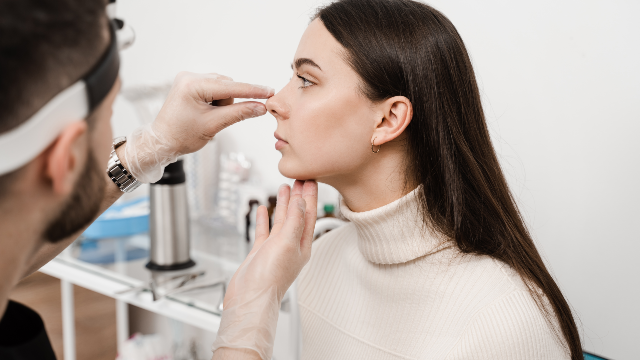
The clinic's documented initial assessment is comprehensive and structural: the nasal bridge, the tip, the septum, cartilage quality, skin thickness, and breathing function. Its ear-cartilage pathway adds a thorough structural and airway assessment performed by an ENT specialist. Across the wider rhinoplasty program, assessment covers facial harmony, nasal anatomy, breathing function, cartilage availability, and what you are hoping for.
Mayo Clinic's account of the physical examination explains why each of those items is on the list. The examination looks at your facial features and at the inside and outside of the nose, and it establishes two separate things at once: what changes are needed, and how physical characteristics such as the thickness of your skin or the strength of the cartilage at the end of your nose will affect the result. It is also, Mayo notes, the step that determines how a reshaping operation will affect your breathing.
Skin thickness in particular is worth understanding before anyone shows you a simulation. It governs how much of a change to the underlying framework will actually read on the surface — which is why it is assessed early rather than discovered afterward.
Step Three: Three-Dimensional Imaging
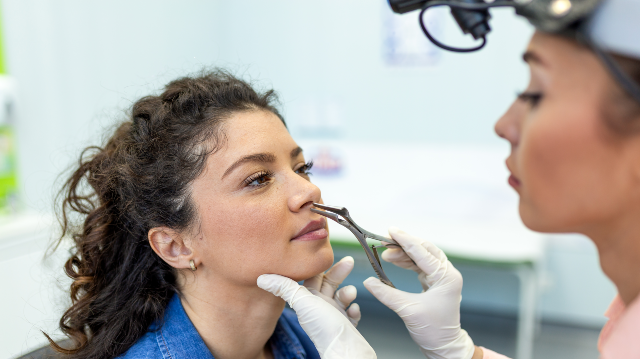
JNB Clinic uses three-dimensional CT analysis as a standard part of nasal evaluation and surgical planning, and its broader rhinoplasty program uses high-resolution 3D facial scanning of contour, skin thickness, and existing structure.
What that imaging is for depends on which half of the problem it is answering. On the functional side, CT is used where clinically indicated to map the septum, the nasal valves, the sinuses, and the nasal bones. On the aesthetic side, scanning supports analysis of nose length, facial ratio, and nasal line angle, which in turn informs an individualized design rather than a standard template. In revision cases, the clinic's documented process includes review of previous surgeries, assessment of nasal shape and function, cartilage availability, skin and soft tissue condition, and detailed anatomical analysis using 3D CT imaging.
Mayo Clinic's description of the photographic stage covers the related ground: images are taken from several angles, some surgeons use software to show possible outcomes, and the photographs serve as reference during surgery as well as before-and-after comparison. Mayo's framing of their purpose is the useful one — the point is to make the conversation about goals specific rather than general.
A caution the clinic states itself: approved claims for its rhinoplasty program cover 3D-scan-based planning and correction considered in the context of whole-face balance, while promising a specific measurement, a symmetry outcome, or a particular degree of correction is explicitly avoided. A simulation is a discussion aid. It is not a commitment.
Step Four: Cartilage Planning
This step is specific to an implant-free practice, and it is where the clinic's technique choices get decided rather than assumed.
The documented preparation includes assessment of autologous cartilage donor sites — septum, ear, or rib — to determine the most suitable source for your case. The clinic's three signature techniques each correspond to a different structural job: KE-Co draws on ear cartilage for nano-structural refinement, worked through a closed endonasal route; Krib-Co draws on rib cartilage where a full structural rebuild is required; KB-Co pairs septal with ear cartilage, again leaving no external incision. Which applies is decided after the anatomy is assessed, not in advance of it.
Mayo Clinic's general description confirms the underlying logic: how the bone or cartilage is changed depends on how much must be removed or added, on the structure of the nose, and on the materials available, with cartilage for smaller changes commonly taken from deeper inside the nose or from the ear, and rib cartilage or other material used for larger reconstructions.
If a technique is named before anyone has looked at your septum, that is a reasonable thing to ask about.
Step Five: The Plan, the Risks, and the Recovery
A consultation that stops at the design is incomplete. The documented pre-procedure process includes a final review of the surgical plan, the expected results, and the recovery process before surgery, along with guidance on medications, lifestyle adjustments, and precautions beforehand.
Risks belong in that conversation explicitly. The clinic's own material states that while working with your own cartilage is intended to reduce complications associated with artificial implants, inflammation, scar tissue formation, tissue contracture, asymmetry, and the need for revision surgery remain possible in any nose operation. Its hybrid septal-and-ear technique carries a longer published list: swelling, bruising, pain, infection, bleeding, temporary or persistent nasal blockage, changes in smell, asymmetry, graft displacement, warping or absorption of cartilage, contour irregularities, and the possibility of revision.
Mayo Clinic's independent risk list overlaps substantially and adds the recovery horizon that patients most often underestimate. Most internal dressings stay in place for one to seven days; an external splint is usually worn about a week; eyeglasses must be kept off the nose for at least four weeks; eyelid bruising can persist for two to three weeks; and swelling of the nose can last considerably longer, sometimes up to a year. Mayo also notes that the nose keeps changing throughout life, which makes the idea of a single fixed endpoint misleading, and that a second operation, if one is considered, should wait at least a year.
What to Ask While You Are in the Room
ASPS publishes a consultation checklist that works as a script. It asks about the surgeon's training and the length of it, about hospital privileges, about whether the surgical facility is accredited by a recognized agency or state-licensed, about whether you are a good candidate, about where and how the procedure will be performed, about the recovery period and the help you will need, about the risks and how complications are handled, about your options if you are dissatisfied with the outcome, and about before-and-after photographs and what results would be reasonable for someone with your anatomy.
ASPS frames the underlying point well: results depend on open communication and on the two of you working toward realistic goals together, and an understanding of your motivation is part of what determines whether surgery is the right choice at all.
Mayo adds one more item for the aesthetic discussion. Because facial proportion is relative, a small chin can make a nose look larger, and a surgeon may raise chin surgery as an option for balance. It is not required. It is the kind of thing worth hearing about before you decide what the nose alone should do.
Practical Details for an International Visit
The clinic's hours run 10:00 to 19:00 on weekdays and 10:00 to 16:00 on Saturday, Korean time, and it does not open on Sundays or public holidays. Korea is fourteen hours ahead of U.S. Eastern Standard Time, thirteen during U.S. daylight saving, which is worth checking against your flight schedule before you book.
Two points from the CDC's Yellow Book are worth carrying into the visit. First, request copies of your medical records in English and provide them to any clinician who treats you afterward, and disclose your full travel and treatment history. Second, arrange follow-up at home before you leave: the CDC recommends identifying a physician in your own community who is willing to provide follow-up or emergency care on your return, and advises against delaying care if you suspect a complication. The clinic provides remote follow-up for international patients after they return home, but that is a complement to local care rather than a replacement for it.
You can look through patient reviews and before-and-after photographs before the appointment, with the ASPS caveat in mind that the right comparison is not the most flattering case but the one closest to your own starting anatomy.
The Bottom Line
- The documented sequence at JNB Clinic runs history, nasal examination, three-dimensional imaging, cartilage donor-site assessment, and then an individualized surgical plan.
- The examination is structural: bridge, tip, septum, cartilage quality, skin thickness, and breathing function, with prior surgery or filler reviewed.
- Imaging is used to map the septum, valves, sinuses, and nasal bones, and to analyze nose length, facial ratio, and nasal line angle for design.
- Technique selection follows anatomy; the clinic avoids promising a specific measurement, symmetry outcome, or degree of correction.
- International patients may begin remotely, and should leave with records in English and a follow-up clinician identified at home.
Frequently Asked Questions
How long does a rhinoplasty consultation take?
That depends on the complexity of your case and whether imaging is performed on the day. What the clinic documents is scope rather than duration: personalized evaluation, diagnosis, and treatment planning based on your condition, within clinic hours.
Can I have the consultation before I fly to Korea?
International patients may complete an initial consultation remotely before traveling, and the functional nasal surgery pathway can likewise begin with a teleconsultation. Physical examination and imaging happen in person.
Will I see a simulation of my result?
Imaging and 3D analysis are used in planning, and Mayo Clinic notes that some surgeons use software to show possible outcomes. Treat any such image as a discussion aid — the clinic's own published position avoids promising a specific measurement or symmetry outcome.
What should I bring?
A complete medication list including over-the-counter products and supplements, your relevant medical history, details and records of any previous nasal surgery or filler, and a written list of your questions.
What if I have no breathing complaints at all?
Breathing function is still assessed. Mayo Clinic notes that the physical examination is what determines how a reshaping operation will affect your breathing, which makes the assessment relevant whether or not you currently have symptoms.
How soon after surgery can I fly home?
Per the CDC, ASPS advises waiting seven to ten days after a cosmetic procedure on the face, the eyelids, or the nose before flying, and the CDC adds that an operation and a flight raise clot risk independently of each other. Your own timing should be confirmed with the clinic.
What questions matter most?
The ASPS checklist: training, facility accreditation or licensing, your candidacy, where and how the operation will be done, recovery and the help you will need, the risks, how complications are handled, and what happens if you are dissatisfied with the result.
This article is offered for informational purposes and educational purposes only. It describes a documented consultation process, is not a self-diagnosis tool, and does not establish whether rhinoplasty is suitable for you; that determination rests with a qualified medical professional who has examined you.
More Articles
Continue reading our clinical guides.

Benefits of Stem Cell Therapy for Skin Rejuvenation
Discover the benefits of stem cell therapy for skin rejuvenation, including improved texture, reduced wrinkles, and a more youthful appearance.
Learn More

Recovery After Autologous Cartilage Nose Surgery
Learn what to expect during recovery after autologous cartilage nose surgery, including healing timelines, aftercare tips, and results.
Learn More

Revision Rhinoplasty: Everything You Need to Know Before Your Second Nose Surgery
Revision Rhinoplasty: Learn what to expect from a second nose surgery, including risks, recovery, and results. Explore your options and learn more.
Learn More